According to a July 2026 press release by GoTo, the parent company of the original Gojek super app, in the first 6 months of the year 2026, it reported net revenue of Rp 10.99 trillion (up 28.45% year-on-year) and a net profit of Rp 607.48 billion.
This goes to show the popularity of the Gojek app, which an Indonesian company launched. Companies want to develop a Gojek clone app revenue model to generate additional revenue streams and replicate that success. This is where V3Cube comes in.
We have created XJekPlus, an ultimate multi-service super app that has been inspired by Indonesia’s Gojek. This clone app gives utmost priority to Gojek clone app monetization.
This is where it gets exciting, as the Gojek clone revenue model that we have adopted is bigger, better, and more advanced. It comes with enhanced features and an intuitive design, which ensures convenience at the next level.
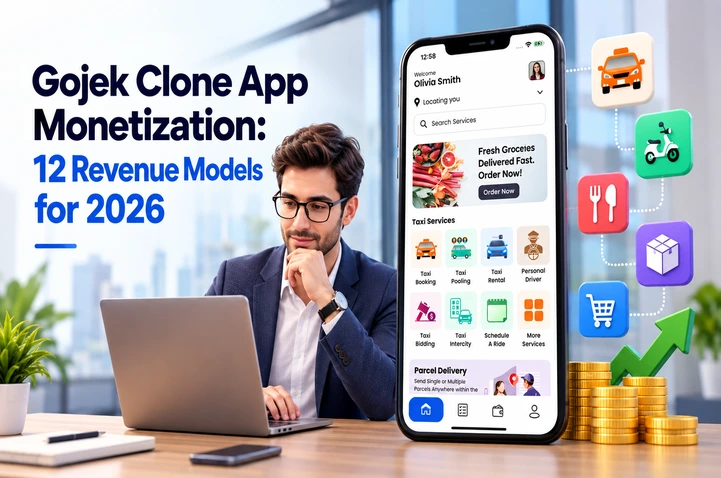
In this blog, we have suggested 12 revenue models for a Gojek clone app for 2026 that can scale up your profits and take your business to success very quickly. Here is the list:
- Commission Per Booking
- AI Surge Pricing Revenue
- Third-Party Advertisement
- Driver Subscriptions
- Store Subscriptions
- Referral Program
- Delivery and Service Charges
- Cancellation Fees
- Loyalty Programs and Memberships
- Affiliate Partnerships
- Convenience & Platform Fees
- GoCorp and B2B Services
What Makes Entrepreneurs Opt for the Gojek Clone Business Model?
Entrepreneurs find the business model of the Gojek clone app attractive as it addresses the pain points of the users that they face in their mundane lives. On top of that, it also solves the convenience issue at scale. When a single app can touch multiple verticals such as rides, deliveries, and home services, it helps provide:
Higher customer lifetime value
Users keep returning for different needs instead of only a single one. This helps in improving the customer lifetime value.
Lower customer acquisition cost per service
A single user once acquired for food delivery might also avail of services for booking a ride or a home repair.
Diverse Income Streams
The income streams that you generate are not contingent upon a single vertical or a particular season.
Network Effects
When there are more service providers on the Gojek clone app, it attracts more customers, and more customers attract more providers.
Top Revenue Models for Gojek Clone App Monetization in 2026
It is obvious by now that a Gojek clone app does not depend on a single revenue stream. And so there are lots of monetization options that you get when you choose a Gojek clone app development from a reputed Gojek clone app development company in the USA.
1. Commission Per Booking
A set commission percentage is what you earn on every ride, delivery, or service booked through your app. The driver or service provider keeps the remaining percentage. A prime example of that is that, at a 30% commission rate, a US $10 booking is likely to generate US $3 in commission on the basis of the rate you set.
2. AI Surge Pricing Revenue
During peak hours, bad weather, or big events, the AI automatically increases fares. The additional revenue that you make from the AI surge pricing goes directly to you.
3. Third-Party Advertisement
Promotional campaigns and banner ads are some of the third-party advertising ways through which local businesses, restaurants, brands, or stores get promoted with the same app. This enables you to earn advertising revenue. It also assists partners in reaching a wider array of customers. A good example of that is a local restaurant paying US$ 300 per month to promote its offers in your app, and ultimately you get US $ 300 per month of additional income.
4. Driver Subscriptions
You charge monthly, biweekly, or weekly subscription fees from the drivers so that they can be listed on the platform irrespective of the number of bookings they finish.
5. Store Subscriptions
Store owners get to display their services on the app, for which they are charged a monthly, biweekly, or weekly subscription to get their business brand listed on the platform.
6. Referral Program
Through this revenue model, you have the scope to expand your customer base with the help of referral campaigns where existing users invite friends to join your platform. This helps you to increase the number of bookings and, at the same time, reduce the costs involved in customer acquisition.
7. Delivery and Service Charges
You charge customers a delivery fee for food, grocery, and parcel deliveries. It also gives you an opportunity to charge based on the item’s total value so that you get to earn additional revenue.
8. Cancellation Fees
In the taxi booking service, there are times when a rider cancels the ride at the last minute. To ensure that it does not happen repeatedly, the admin can charge cancellation fees for a confirmed booking so that there is no misuse and providers are properly compensated for their reserved time or resources.
9. Loyalty Programs and Memberships
When you enrol in a premium membership or loyalty program, it encourages users to make recurring purchases and provides them with free deliveries, priority discounts, or discounts, and at the same time helps generate upfront subscription revenue.
10. Affiliate Partnerships
This revenue model allows you to partner with third-party brands, whether they are offering financial services or retail brands, while offering their products within the app. This allows you to earn referral commissions.
11. Convenience & Platform Fees
A flat fee is added to every transaction so that it can cover customer support, platform maintenance, and payment processing, which is very nominal yet a consistent revenue booster.
12. GoCorp and B2B Services
Corporate clients that use GoCorp pay for employee transportation management, centralized billing, and fleet access, which helps generate predictable and recurring revenue with lower churn compared to consumer accounts. Corporate clients who integrate Gojek into their travel policy will not switch platforms on a casual basis.
Final Words
The success of a Gojek clone app is not merely about replicating the features of the main app; it is also about developing a Gojek clone app monetization strategy that works seamlessly and adjusts according to the market conditions.
The first seven revenue models that we have covered are provided by V3Cube, and, to be fair, they are much better alternatives than the remaining five.
Remember, when you have revenue models such as commissions, delivery charges, and subscriptions, it creates a good base for entrepreneurs to develop Gojek clone app revenue streams.
This is where a Gojek clone app development company such as V3Cube comes into the picture, as it helps your business launch a multi-service platform and gives you the ability to scale it as and when the user base grows.
FAQs
What is the most profitable revenue model for a Gojek clone app?
Commission-based revenue is the most consistent revenue model. However, when you integrate it with delivery fees and subscription plans, you end up getting higher margins.
What is the commission rate that Gojek clone apps typically charge?
The commission rates typically range from 10% to 30%. It is totally dependent on the market competition and service category.
Is it possible for me to add new revenue streams after launching my app?
Definitely! At V3Cube, we develop a Gojek-like app that allows you to add new monetization features like featured listings or loyalty programs without rebuilding the app from scratch.
Which revenue model is best: commission-based pricing or a subscription model?
It is challenging to select either. A better approach would be to use a hybrid methodology wherein a subscription model is used for consistent income, and commission-based pricing helps in scaling as the number of transactions increases.
Is it mandatory to develop a custom-built app to implement all these revenue models mentioned in this blog?
Not every time! You need a Gojek-like app provider, such as V3Cube to implement all these revenue models mentioned in this blog simultaneously and thus save time and development costs.

Chirag Darji is the CEO of V3Cube, specializing in building on-demand mobile apps and providing mobility solutions for companies around the world. With extensive experience in strategic planning and innovation, he helps entrepreneurs worldwide launch, scale up, and grow successful digital businesses.