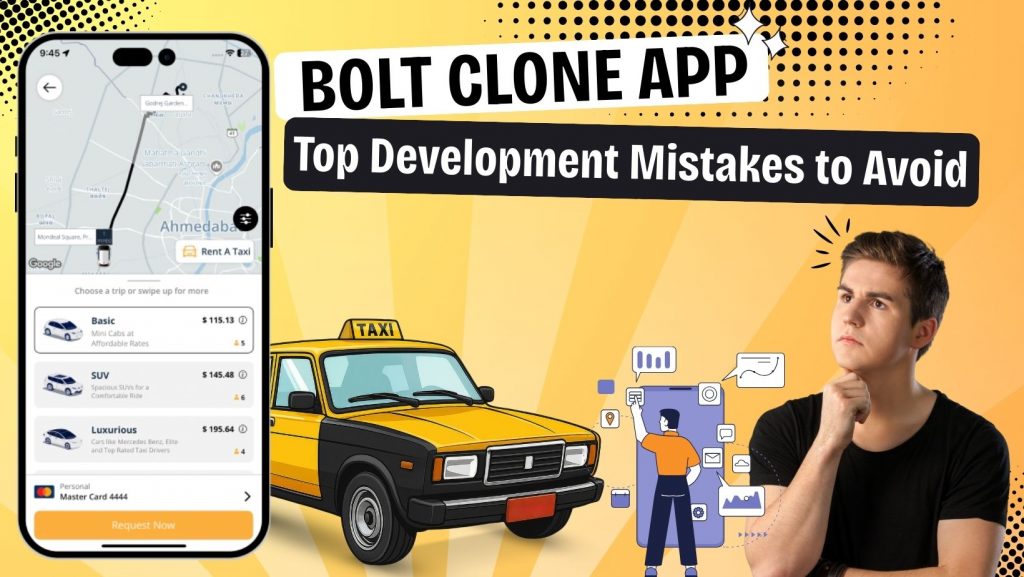
Mistakes are human nature. We often make mistakes that teach us about life. But when there’s a talk about business related mistakes, it’s often hard to ignore that you lose money. Many times, things are very messy, you’re confused, and you make mistakes that cost you hefty amounts. In many of the app launches, a simple observation has come out, let’s talk about it.
Building a Taxi App Similar to Bolt is a great choice, many startups grow with white-label Bolt Clone Scripts, but sometimes people make 5 critical mistakes that become an obstacle in the success of their Ride-Hailing App. In this blog, let’s address it elaborately. Continuing from here, you are going to have a deep dive into mistakes that you need to prevent, because prevention is always better than cure.
Before we deep dive, let’s just take a brief glance at Bolt Clone.
A Clear Understanding of Bolt Clone
Bolt Clone is basically a Taxi App Solution, perfect for entrepreneurs who want to launch their own Taxi App. A Bolt Clone is inspired from the Taxi App, Bolt, operating in Europe, South America, and African Continent. The Solution includes User & Driver Apps in Android & iOS systems, a Website, Admin Panel and supporting Panels. There are White-Label Scripts available along with custom development options.
Now, you know about the Bolt Clone Solution, so let’s talk about the mistakes that you need to avoid.
Mistake 1: Choosing the Tech Partner
If you’re a non-tech founder, you might already be finding agencies, and Mobile App Development Companies, but here’s the secret—no one will tell you what their product is without the marketing layer. So, reading through the blogs is important.
Another very big choice comes between White-Label Bolt Clone Script and a custom development agency, now to simplify the difference without any BS, here’s a table.
| Aspect | Bolt Clone | Custom-Made Taxi App |
| Development Time | Fast (1 week to launch) | Longer (12-18 months to build) |
| Cost Structure | Subscription or one-time fee | Higher upfront investment |
| Customization | Limited to templates and add-ons | Fully tailored to unique needs |
| Features | Pre-built core ride-hailing tools | Built from scratch, any feature |
| Scalability | Provider-managed, usage-based | Designed for specific growth paths |
| Maintenance | Can be self-handled, 1 year of free support is usually included | In-house team required |
| Integration | Plug-and-play with required APIs | Custom APIs for exact requirements |
Choose according to what you need, if you need fast launch, with Good customization, and a scalable infrastructure, you can choose a Ready-made Bolt Clone Script.
Mistake 2: Not Deciding Feature Set
Features are the core of any app. They sell your app, they make the app smooth, fast, and reliable. In your specific region you should choose with a feature set that they require. Some of the basic features are mandatory for any region, such as:
- SOS Safety Button
- Real-time Tracking
- Earnings Report
- Heatmap View
- OTP Verification for Rides
These features are mandatory for any region. However, you should definitely consider some advance features based on the region like:
- AI Powered Dynamic Pricing
- Smart Fare Calculation
- AI Discount Codes
- AI Powered Route Matching
- Taxi Booking WhatsApp Chatbot
- Multiple Languages & Currencies
Mistake 3: Wrong Tech Stack
App Development is usually based on different code and tech stack that is chosen. Many develop in Flutter or ‘React’ Native, but hold on here, do you know what’s different in all of them? If not, you should know about it, let’s discuss that.
Cross Platform:
Also Known as hybrid, this tech stack is usually built in Flutter, where everything relies on a single code, it is built like a web app, and is not very good for scalability.
Native Platform:
Now, here the confusion lasts longer, because Native has 2 models. Each one defined with different tech stack, meanwhile the backend here remains the same.
1. React Native, is again cross-platform framework that uses React to develop the code. It is reliable but only for a certain usage.
2. Traditional Native, is a harder version, more traditional, but more effective method. It uses a large tech stack, using Java, Kotlin, Swift, PHP, MySQL, Node.js, etc. to build your whole framework and run paralleled.
If you want a scalable infrastructure, which no one denies to, you’d need Traditional Native, ask for the tech stack from the White-Label Firm before purchasing the Bolt App Clone Script.
Mistake 4: No Marketing Strategy
Now this is the big one, even if your app is the best, without marketing, it will just develop cache and nothing more or less. That’s why you need to focus on marketing your Bolt Clone App effectively. Many founders rely on these sources to generate buzz and advertise their Ride-Hailing App.
SEO
SEO is like the organic growth engine for your app. With the website you get, add authority to it by writing blogs, include information, updates, and much more to reach audience effectively.
PPC
PPC is the pay-per-click Google ads that you can opt for speed acquisition, these google ads go into the feed of the users who are interested in ride-hailing and you only pay when someone clicks.
Social Media
Social Media is everywhere, be active, the young Gen Z want to ride more, they use the apps in highest amount, develop a good social media strategy and invest in it.
ASO
ASO (App Store Optimization) is among the biggest growth channels. Google Play Store and Apple App Store have guidelines for it, read it, implement it, and boom you’ll see new downloads.
Mistake 5: No Post launch Support Plan & Compliance
Ignoring post launch maintenance and Compliance is praying for the doom. But let’s be honest, you’re not in a K Drama where everything works out fine because you took the first step. In reality, you should be aware of how compliance works in your country and align the feature set accordingly.
If you’re from Europe, GDPR compliance and registration is necessary.
Meanwhile, Post Launch support is like the raider of your mercenary. It makes sure you are future ready, it handles all the bugs & changes effectively. So, they are mandatory just like features. But the mistake here is settling for less, many people would tell you this same thing and add a soft marketing layer, very subtle, saying, “You need tech support, and we do provide it, Enjoy!” But in reality it’s useless, because it’s still not future ready. If you’re choosing a White-Label Firm, you must ensure a simple checklist that defines if the firm is a money looting scheme or a good, reliable tech partner.
How These Mistakes Impact Bolt Clone ROI in the Long Term
Most founders think ROI ends at launch, but the real returns of a Bolt Clone start after users and drivers come in. A wrong tech stack or weak tech partner may look fine early, but as traffic grows, money shifts from scaling to fixing bugs and rewriting code. Instead of growth, you enter damage control mode.
Poor feature decisions increase user and driver churn, which silently raises marketing costs and reduces lifetime value. Hybrid or non-native architecture also slows expansion into new cities. While you struggle to scale, competitors move faster and capture the market.
Without marketing, even a good app stays invisible and delivers zero return. Weak post-launch support and compliance gaps lead to downtime, lost rides, and frustrated users. These mistakes don’t fail your Bolt Clone instantly, they slowly drain profits. A solid foundation protects ROI through smoother scaling, lower maintenance, and steady growth.
Wrapping it up,
Building a Bolt Clone App is exciting, no doubt about it. You see the market, you see the demand, and you want to move fast. But speed without clarity is where most founders trip. Not because they are careless, but because app development looks simple from the outside and messy on the inside.
Every mistake we discussed above comes from one root cause, taking decisions without fully understanding the long-term impact. Choosing the wrong tech partner, ignoring native technology, copying features blindly, launching without marketing, or skipping post-launch support, these things don’t break your app on day one. They slowly drain your time, money, and patience.
A good Bolt Clone is not just about launching in one week. It is about what happens after that week. Can your app handle more users? Can it support local rules? Can it evolve when the market changes? That is where the right tech stack, the right feature set, and the right white-label partner actually matter.
If you avoid these mistakes early, you save months of rework and a lot of unnecessary expenses. Ask the right questions, understand what you are buying, and think beyond the demo screen. Because in ride-hailing, fixing things later always costs more than doing them right from the start.
Simple rule, build smart first, scale fast later. Start with a real-time demo today.
FREQUENTLY ASKED QUESTIONS
1. What are the most common mistakes founders make while developing a Bolt Clone app?
Most founders rush the tech partner selection, ignore native scalability, and launch without a clear feature and marketing plan.
2. Is a white-label Bolt Clone script good for long-term business growth?
Yes, if it is built on native technology, offers scalability, and comes with strong post-launch support.
3. Why is native technology important for a Bolt Clone app?
Native tech handles high traffic better, performs faster, and scales smoothly as users and drivers increase.
4. How quickly can a Bolt Clone app be launched?
With a ready-made Bolt Clone script, you can launch in as little as one week if requirements are clear.
5. What post-launch support should a Bolt Clone app include?
It should cover bug fixes, server monitoring, updates, and compliance support based on your country’s regulations, and 2 years of annual upgrades.