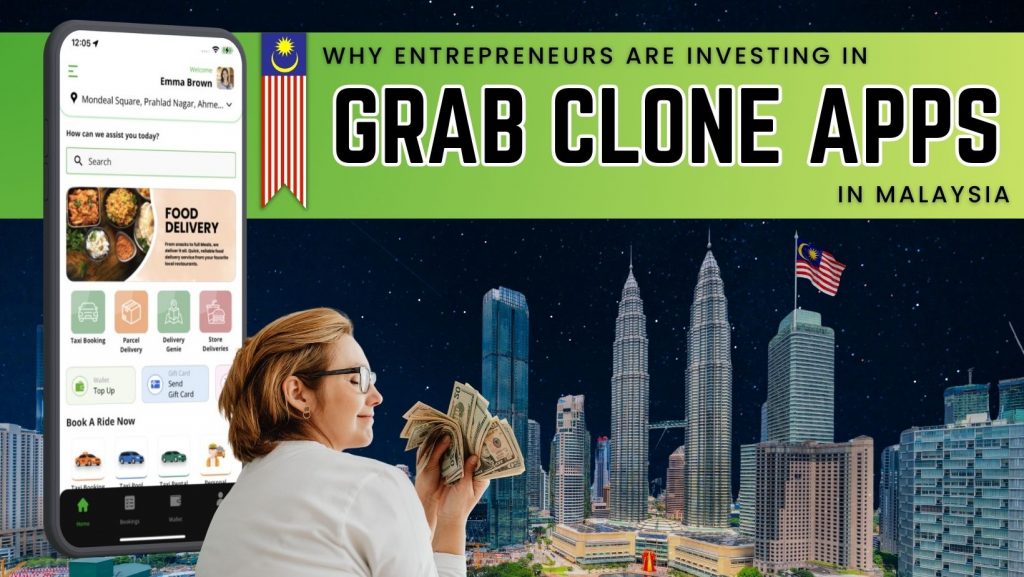
The right question exists for you because you plan to launch a Grab Clone in Malaysia. The article explains economic concepts through practical examples instead of academic spreadsheet demonstrations. The document provides practical reasoning to assess Grab Clone return on investment while explaining key revenue drivers and showing how white-label Grab Clone solutions determine whether businesses succeed or fail.
The Reality of Malaysia
The super-app model has reached complete adoption in Malaysia because it serves as a main market for the Southeast Asian ride-hailing industry. The local Grab service operates extensively throughout major cities and towns which creates customer expectations based on established market leaders. Users require a complete basic service package while drivers need dependable pay and effective technology. Your business will experience growth problems if your product fails to meet customer expectations from its initial launch.
Grab Clone ROI Explained!
Entrepreneurs who inquire about Grab Clone ROI seek to obtain a precise financial measurement. The inconvenient truth about ride-hailing clone ROIs states that their value depends on the sequence of product development and market entry and operational activities. A successful ROI story typically follows three acts: rapid adoption, expanded monetization, and operational efficiency. Each act has different cost drivers and revenue levers. The faster and cleaner you can move through those acts, the healthier the ROI will be over the long term. The relationship between operational acts and better return on investment results shows that faster execution leads to increased financial success.
How Does Grab Clone Earn Money?
Let’s keep this actionable. When you consider Revenue Models in Grab Clone, there are a number of tested and proven models to consider:
- Transaction fees and commissions – the main revenue earner for every ride and delivery.
- Dynamic pricing and surge – increasing the revenue per ride during times of high demand.
- Subscription and membership – providing stable revenue from frequent users.
- In-app advertising and promotions – monetizing the user base for third-party revenue.
- Value-added services for drivers and merchants – providing insurance, fuel cards, and micro-finance.
- Ancillary services – providing parcel delivery and grocery delivery.
Each of these revenue models has the potential to increase the ROI of the Grab Clone. Each of these models requires different levels of investment in features and systems to enable the revenue streams. A ride booking only solution will leave money on the table compared to one that is architected to enable merchant and financial services.
How to Determine Costs of Developing a Grab Clone?
The evergreen question is “How Much Does Grab Clone Cost?” The temptation to throw out a price range at you and be done with it is strong, but that would be useless to you. What’s more useful is to focus on the areas that drive the cost so that we can better control it:
- Product development: The core rider app, driver app, admin dashboard, dispatch logic, matching logic, payment gateway integration, mapping/routing integration, etc. Making it multi-service like delivery or grocery would add complexity to the cost.
- Technology infrastructure: The servers, database, real-time messaging systems, scaling to handle peak load demands, security, compliance, etc. Don’t skimp on this or you will regret it later with outages or loss of customer trust.
- Legal Compliance: The business requires compliance with local legal requirements through its operational licenses and e-hailing laws and merchant contracts which need to be negotiated. The costs associated with these requirements will differ for each city because of their various requirements which will be unknown to you.
- Smooth Onboarding: The business requires driver acquisition through its driver onboarding process and driver verification methods while offering financial incentives to drivers during the initial part of the business operations and establishing quality control systems which will ensure service delivery standards.
- On-going Support: Applications require ongoing development because they need regular updates and bug resolution and new functionality implementation.
If you control and optimize these buckets, you control the cost curve. The very cheapest solution up front often becomes the most expensive over time because technical debt and poor UX kill user retention.
Why a white-label Grab Clone is a pragmatic choice?
The purpose of White-label Grab Clone products is to assist users in achieving their startup goals through their existing system without requiring any system redevelopment. Here’s why they are worth serious consideration:
- Speed to market, without sacrificing essential features: a mature white-label solution gives you production-ready rider and driver apps, admin panels, and tested dispatch logic. The reason this matters is that market windows close fast.
- Core technology risk is lower: White-label ride-hailing vendors have already solved the problems of failure points, payment integration, and mapping issues in various cities.
- Customization: A good white-label solution allows you to customize branding, pricing, loyalty programs, and partnerships so that you don’t roll out a generic copycat solution but a market-ready solution.
- Upgrades and support: When you have an active vendor, you get access to upgrades, bug fixes, and compliance changes without having to rebuild everything from scratch.
- Growth: When you are not waist-deep in infrastructure and platform development, you can focus on building relationships with drivers and marketing, which is where the real money is made.
The field of white-label solutions presents varying degrees of effectiveness. You want one that gives you source-level control or flexible APIs, plus transparent SLAs for uptime and support.
How to think about profitability?
- Begin your analysis with unit economics. Unit economics should be used as initial guidelines which do not determine final outcomes. The analysis needs to focus on contribution margins which show typical trip expenses after deducting driver payouts and payment fees and operational costs.
- The company should give priority to retaining existing customers instead of acquiring new ones. The cost of maintaining a rider or driver relationship remains lower than acquiring new customers because each retained user generates additional returns through ongoing business activity.
- The platform development process needs to create systems which enable feature addition through future expansion. Your active user revenue will experience significant growth when you establish the capability to introduce delivery and merchant payment systems through partial system upgrades.
- The company should achieve better results by reducing all operational expenses. The combination of dispatch efficiency and routing algorithms together with demand forecasting solutions leads to decreased unnecessary journeys and unoccupied travel distances.
- The company needs to evaluate its danger from regulatory changes. A single local compliance problem will create an operational crisis which requires funding together with staff resources to manage upcoming regulatory developments.
This is the practical path to positive Grab Clone ROI. Treat costs and revenue as parallel levers you tune together, not sequential decisions you make in isolation.
Final Word
However, a profitable Grab Clone in Malaysia is not a magic trick, and it is not something that happens once and for all. It is a strategy that is repeated and perfected. Costs are not strategies, and profitability is not a strategy. It is an outcome of product-market fit, operational excellence, and monetization strategy.
However, if you want to speed up this process, a reputable white-label Grab Clone can be your shortcut to save your capital while still getting you a product that’s already market-ready. It saves you time, reduces your risk, and allows you to spend your precious budget on things that actually drive results, such as driver programs and local marketing.
However, if you want, I can provide you with a launch plan that’s specific to your city in Malaysia, or I can outline for you the revenue model that’s best for your targeted customer segment, not based on any range, but on priorities and steps.