Having an idea to create a Gojek clone app is one thing, but converting it into a profitable venture is something not many businessmen have aced yet.
The Gojek clone app ROI is a highly anticipated topic amongst budding entrepreneurs; after all, who doesn’t want to earn profit?
It usually takes between a year or two for a multi-service Gojek app to turn profitable. Yes! It is true that you can launch the software within a span of two to four weeks using a well-defined white-label Gojek clone script.
However, the profitability aspect is still dependent upon overcoming high customer acquisition costs, scaling transaction volume, and building provider density.
Remember, perfecting this art of Gojek clone app profitability can take your Gojek clone business to a new level of success. This is your chance to achieve this feat by going through this write-up.
We will look at the key stages of Gojek clone app profitability, factors that affect the timeline, and the primary ROI drivers and revenue streams to ensure that your Gojek-like app turns profitable at the earliest. So, let us get started.
The Best Way to Calculate Gojek Clone App ROI
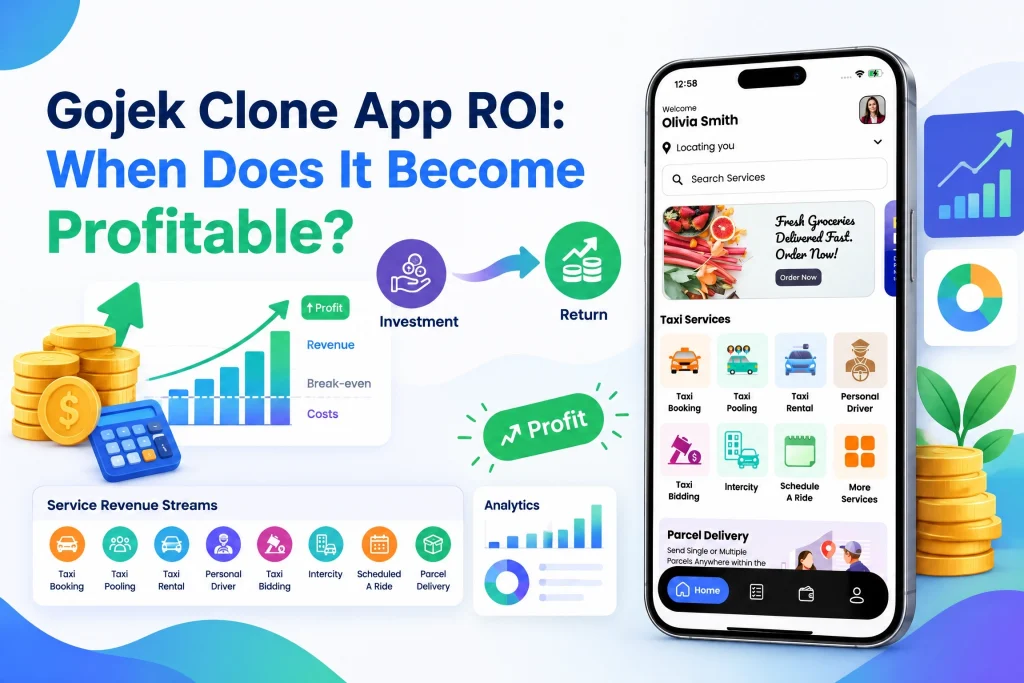
When it comes to calculating Gojek clone app ROI, you must subtract your total development and operational costs from the total revenue. The number you get needs to be divided by your total costs and then multiplied by 100.
Take into consideration multi-stream revenue streams such as vendor subscriptions, booking commissions, and surge pricing.
This is where you need to factor in these things.
The total investment in terms of cost. This would include –
- Initial investment/white-label Gojek clone development cost: Consider it to be between US $20,000 and more than US $150,000. The exact amount will depend on whether you go for a feature-rich super app business model or purchase a basic Gojek clone script.
- Customizations and Integrations: What kind of customizations do you want it to have? Whether it is the addition of payment gateway integration or customizations that make your brand look different from your competitors. This cost shall be added.
- 24/7 Operations: Server expenses, round-the-clock maintenance, and more should be added to the initial investment, which should be about 10%-20%.
- Marketing Cost: The brochures/flyers that you create, which are part of the marketing cost, shall be added. This will help you get the overall initial investment in terms of cost.
Next comes the calculation of the revenue streams. This includes –
- Commissions charged for in-app advertisements from Service providers: This can range between 10% and 20% of the total sales.
- Surge Pricing: Whenever there is bad weather or peak office hours, a surge pricing amount is charged by the driver to the rider. This can increase the transaction values.
- Vendor Subscriptions: Vendors must pay a subscription fee for displaying their services on the app. Whenever their services are availed, they are charged commissions.
The multi-service app ROI (in terms of percentage) is calculated by dividing total revenue minus total cost by total investment cost and then multiplying it by 100.
How Long Does It Take for the Gojek Clone App to Turn Profitable?
The Gojek clone app profitability has different stages of profitability. Here they are:
- The Launch Period to 6-Month Stage
- 6 Months to 1 Year Stage
- 1 Year to One-and-a-Half Year Stage
- One-and-a-Half to More than 2 Years Stage
Let us dive deeper into these stages.
The Launch Period to 6-Month Stage
This is the stage where you are setting up the stage for your growth. During this stage, you ensure that the multi-service app works smoothly across a limited area with a few users.
This is where you concentrate on satisfying the limited users and start acquiring vendors and onboarding them smoothly.
It is also when you ensure that there are zero operational bottlenecks. Remember, the marketing cost of the app should never outgrow the commission revenue.
Check the early app downloads. This can give you a minute detail as to how many users actually find your app easy to use. It also gives you a chance to see whether the marketing activities that you carried out are paying dividends at the initial stage.
This is the phase where you do not make any profit.
6-Months to 1-Year Stage
During these six-month period, you must set goals for the number of daily active users you wish to hit on a weekly basis. Also, make sure that you check whether users are making effective use of two to three core services such as ride-hailing and food delivery.
This is also the stage where you try to attain local density. The initial phase of giving discounts is gone.
It is during this phase wherein you actually think about growing your gross revenue through 15 to 30% transaction commissions. However, the earnings get reinvested into the operations, thereby decreasing the net profits.
1 Year to One-and-a-Half Year Stage
During these six-month period, you can achieve break-even by retaining users organically using referral and loyalty programs.
This is the stage where you can get volumes of commission, which helps in covering day-to-day operational costs, server maintenance, and support staff salaries, which helps in achieving a slight profit margin in cash flow.
One-and-a-Half to More than 2 Years Stage
This is the stage where you can confidently add more services to the existing services in the app. It can even open up a wide array of revenue streams such as in-app advertising, dynamic surge pricing, and vendor subscription tiers.
During this phase, the customer acquisition costs get less and the transaction volume goes higher as time goes by steadily. It is even possible to cross-sell services such as parcel delivery, grocery, and handymen so that you can get a positive revenue return effortlessly.
Factors That Can Affect the Timeline
Here are some of the factors that can affect the timeline of the Gojek clone app’s profitability.
- The Number of Initial Services Offered
- Amount of Competition During the Initial Phase
- The Effectiveness of the Commission Model
- Initial Capital Used
Let us look at these in detail.
1. The Number of Initial Services Offered
Yes! It is true that you can add more than 10 service offerings in a Gojek clone app. But loading yourself with so many services can confuse your target market. It can also increase the user acquisition rate and make operations chaotic.
Remember, the fewer your initial service offerings, the better your app will perform in the targeted market. You can always increase the services as time goes by. This will also improve your confidence level and steadily increase your revenue proportion.
2. Amount of Competition During the Initial Phase
There are two things that you must always make sure of. The first is whether there is a market for the service you are offering and whether it solves the problem of your target audience.
The next is the level of competition that your product or service can handle if launched early.
Both these things can help you grow your business and achieve the level of revenue that you target during the different stages of the Gojek app launch.
3. The Effectiveness of the Commission Model
The type of commission model that you make use of and the amount of percentage involved can also help you transition from one phase to another smoothly.
Remember, a steady 10 to 15% commission rate is always a safer bet than charging a higher commission rate. This will help increase the transaction volume and ultimately improve the ROI of the app in the longer run.
4. Initial Capital Used
The amount of capital that you burn in the initial investment in marketing has the ability to break or make your Gojek clone app ROI. Remember, existing competition can hurt your app, so plan things accordingly. It can also delay your positive ROI in the long run.
Final Words
We have discussed the Gojek clone app ROI, which is essentially a must-read guide for businessmen and entrepreneurs who wish to drive home profit from the app.
From a basic understanding of the calculations of ROI to the different phases, we hope you enjoyed reading this write-up. Keep reading our regular blogs to get more such essential information on Gojek clone app development.
FAQs
Q1. What is the amount of earnings that I can expect with the help of a Gojek clone app?
If you are targeting emerging markets, you can make US $50,000 to US $500,000 on a monthly basis with more than 20,000 active users. The number will largely depend on the market you are targeting, the number of active users your app has, and the number of service offerings your app provides.
Q2. When will I be able to cross the magic number of US $1 million using a Gojek clone app?
The answer will be contingent upon the aggressiveness with which you market your app, the multiple revenue streams already there in the app, and the market you are targeting. Consider it to be within 12 to 16 months.
Q3. Is there a way to launch my Gojek clone app without requiring any development?
Absolutely! A good Gojek clone script can help you develop a Gojek clone app within a week or two. And the best part is, it comprises all the major features that have been battle-tested and pre-built.
Q4. How much commission rate can service providers expect to sell their services on the Gojek clone app?
On average, you can get 15% to 30% commission on every transaction as a service provider while selling your services on the Gojek clone app.
Chirag Darji is the CEO of V3Cube, specializing in building on-demand mobile apps and providing mobility solutions for companies around the world. With extensive experience in strategic planning and innovation, he helps entrepreneurs worldwide launch, scale up, and grow successful digital businesses.