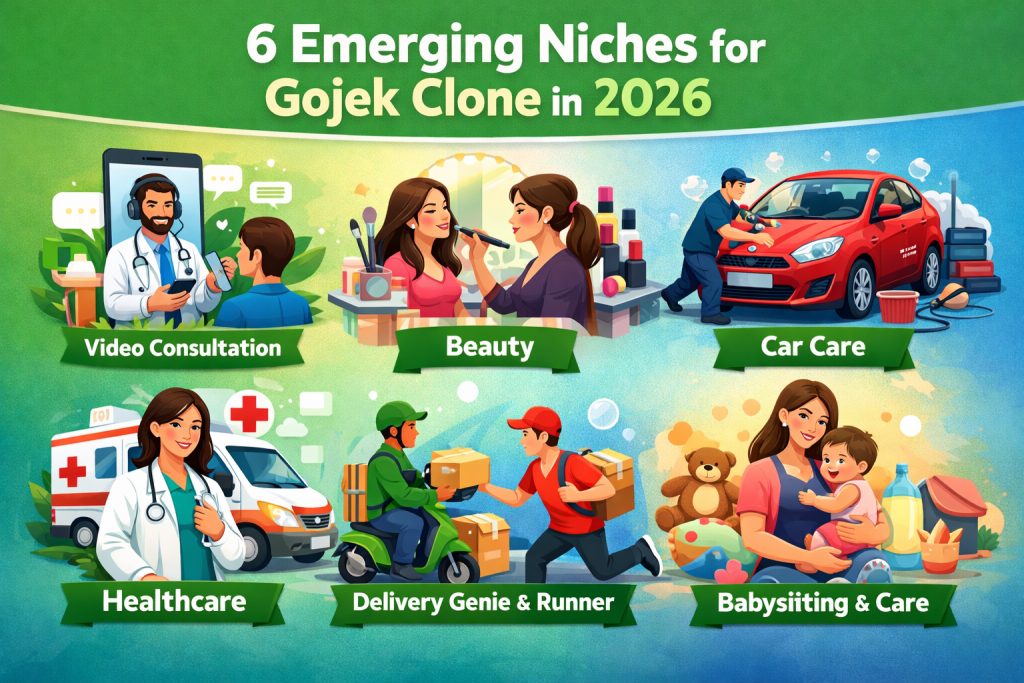
Gojek Clone with Emerging Niches
The super-app revolution did start with one breakthrough idea. It started by making a basic but radical observation that people do not need ten different apps to meet the same needs. They need one platform to handle all their needs. Gojek realized this in 2015 when it grew from an old-fashioned ride-hailing company on two wheels to an entire ecosystem of services. The same principle is being used by entrepreneurs in South Asia, Africa, the Middle East, and Latin America and the most thrilling part to the tale is the fact that some of the best chapters haven’t even been written.
The reason for this is the diversification of niches. Although early Gojek clones were heavily competing with ride-hailing services as well as food deliveries, actual future of the market to be made in the 2025-century and even beyond will be going to service industries which are highly personal with high repeat frequency, and traditionally not served by the digital platforms. If you’re developing or expanding the size of a Gojek clone, these six niches aren’t just a matter of adding to your strategy. They form the strategic basis of the areas where valuations of multi-million dollars are being constructed today.
Video Consultation: The Service Economy Goes Digital-First
Consider the last time you required an immediate professional opinion. Perhaps it was for a legal concern regarding a contract, a nutritionist’s recommendation before embarking on the new diet or a fitness instructor to help you improve your posture. In all of these instances, the old method required the user to travel, sit and pay for your physical presence, which added little value to the service itself.
Video consulting as a service vertical within the Gojek clone fundamentally disrupts this dynamic. The market for this is vast because “consultation” encompasses a variety of professional fields: financial planners, legal advisors therapy, life coaches, tutors, fitness trainers, tutors and even astrologers as well as spiritual counsellors in industries where the demand for this service is high. According to the 2023 Grand View Research report, the telehealth and teleconsultation market was worth more than $87 billion. It is predicted to expand at a rate of 24 percent from 2030.
The reason this particular vertical is effective in a super-app is the trust framework you already have. Anyone who book their delivery of groceries and home cleaning services through your app is more likely to schedule an appointment for therapy or a legal consultation with the same app than an unidentified standalone platform. The cost of conversion is significantly lower due to the trust that has been already built.
Beauty: The Most Loyal Customer Base in the On-Demand Economy
The market for beauty services at home is among the most obvious instances of a need that existed long before infrastructure for meeting it was constructed. The public has always desired salon-quality manicures, haircuts, hair blowouts, and skin treatments without the hassle of a commute, the long wait, or the awkward conversation. The pandemic increased this demand from a luxury need to a broader shift in the way people behave and the practice remains in the majority of cases.
The reason beauty is an intelligently designed market to develop the Gojek clone is the repeat purchase frequency. Customers who book a haircut will return each three-to six week. A client who book gel nails will return each two or three weeks. This is not the episodic behavior of someone ordering a one-time service; it is subscription-adjacent loyalty that generates predictable, compounding revenue. The research conducted by McKinsey in the field of cosmetics has revealed that beauty-related consumers are among the top satisfaction ratings of any category of consumers If your platform provides a fantastic initial experience, retention is nearly automatic.
The key to executing this effectively within a clone framework is solid professional verification and display tools to allow customers to see the work of providers prior to booking, which addresses the most significant barrier to adoption in online beauty marketplaces.
Car Care: The Trillion-Dollar Asset Nobody Is Servicing Well Digitally
There are more than 1.4 billion passenger vehicles around the world and the vast majority of owners are experiencing a highly unhappy relationship with their car maintenance. Finding a reliable mechanic, getting an accurate price estimate, arranging an easy car wash or scheduling a tire replacement are all situations that are remarkably similar in a majority of markets other than The United States and a few Western European cities.
This is exactly the reason why car care is among the most lucrative areas of opportunity in the Gojek clone ecosystem. The problem is real and the frequency is predictable (every vehicle requires maintenance multiple times per year) and the distrust gap with traditional garages is large enough that a verified open, accessible, on-demand option has a significant willingness to pay premium. Within this sector service, the most efficient ones include car washes on the doorstep and basic mechanical inspections. batteries jump-starts and replacements oil changes and even detailing and can all be offered without having a physical garage and keeps your company’s economically healthy.
Healthcare: Where Urgency Meets Underservice
The service vertical of healthcare in a super-app does not mean about replacing hospitals or competing against pharmaceutical chains. It’s about bridging the gap between “I require a medical service today” and “I can schedule an appointment within three weeks.” This gap is where on-demand healthcare takes place and creates a tremendous value.
The services that are specifically scalable most effectively within the Gojek clone healthcare vertical include home samples of diagnostic test, medicines and medical supply deliveries, nursing visits on demand for post-operative treatment, doctor tele-consultations (which connects to the vertical for video consultations by using a specialized application) and physiotherapy at-home visits. The global market for home healthcare was estimated to be $390 billion in 2023 growing at a rate driven mostly by the aging population in the developed world and health access issues in the emerging markets.
The regulatory environment here requires more attention to detail than other verticals. However, it also acts as a natural moat. When you have a right healthcare delivery system within your industry it becomes much harder for competitors to copy it in a short time.
Delivery Genie & Runner: The Everything-Delivered Vertical
All Gojek clones have food delivery. The platforms that are bringing substantial revenue differentiation by 2025 are those which have shifted beyond food to what’s more accurately described as the “anything and at any time” service model for delivery. Delivery Genie, in idea, is essentially the courier-on-demand vertical, which handles pick-ups at pharmacies, grocery store order, documents transfers flower delivery as well as alcohol and beverage delivery, as well as errand-running services where the delivery partner serves as a personal customer.
The reason for this particular vertical is that the the delivery system, when it is built it is cost-effective to be redistributed across different product categories. The driver network as well as the system for real-time tracking and the delivery algorithm as well as payments flow all in the system. The process of adding new delivery categories the top of these is mostly an issue of incorporating the merchant partnership and category-specific UX flows. The potential for revenue growth is nevertheless significant since each category adds an additional segment of high-frequency users to your platform.
Babysitting and Care: The Most Emotionally High-Stakes Niche
In all the areas we’ve discussed, babysitting as well as elder care services have the most emotional risk for the client and that’s the reason they are so effective. If a parent is looking for a person to care for their child, or an adult child is searching for a caregiver for an elderly parent, the price sensitivity decreases drastically. What they’re buying is peace of mind and peace of thought commands the highest price in all markets across the world.
The demand-based childcare and senior care market is growing quickly since dual-income households are becoming the norm in urban areas across the globe. A Gojek clone that builds this segment with strict vetting of the provider and background verification, as well as live monitoring of care sessions and on-demand communication between parents and caregivers is creating something more than the transaction. It’s building a relationship infrastructure and this type of platform stickiness makes it extremely difficult to challenge once it’s established.
The Strategic Thread Connecting All Six
The commonality between these niches is not just potential for growth. They have a structural feature which makes them ideal to a super-app model in particular. Each benefit from cross-vertical trust. This means that a client who has already a relationship with your platform for a specific service is likely to have a much cheaper acquisition cost than any other service you provide. A mother who utilizes your babysitting vertical can be an extremely warm and welcoming lead for your beauty and healthcare verticals. A car owner who utilizes the car-care vertical an ideal match for your delivery services.
This is the benefit that an effective Gojek clone offers that no standalone vertical app could duplicate each new feature that you offer does more than bring in revenue, it strengthens your relationship with every user of your platform. The business owners who comprehend this interconnection and design their strategy of niche expansion around it are the ones who review their work in five years and realize that the multi-million-dollar valuation was not built in the one sector, but rather in the intentional, trust-building accumulation of all of them.