Selecting the suitable technology plan is a significant stage in the establishment of a business that provides multiple services.
The Gojek Clone vs Grab Clone can enable entrepreneurs to choose the types of platforms suitable for the market they are targeting, the strategy they are using, and their objectives for growth.
Both plans are founded on the idea of creating a platform with a variety of services, but the arrangement of these services may vary.
Using either Gojek Clone or Grab Clone allows an entrepreneur to launch their proprietary super app while avoiding all possible troubles with design and research. Understanding the essential characteristics of the product still has to be done regardless of the chosen model.
What Is a Gojek Clone?
The Gojek Clone App refers to a multi-service software solution that implements the super-app model of business. Instead of focusing on only one service, it is capable of combining several services such as transportation, delivery of food and parcels, home services, etc., into one app.
This business model is crucial for any aspiring entrepreneur as it allows them to generate revenue from various services at once. The customer who has downloaded the app for booking a taxi may later use it for ordering food or parcel delivery, as well as any home services.
The biggest benefit of this model lies in building one systematic system instead of several disconnected applications.
What Is a Grab Clone?
The Grab Clone App operates in the same way as Gojek, as it uses a multi-service platform to combine different services like transport, delivery, and other services available on demand.
A business using this model can start with a smaller number of services and expand over time. The Grab Clone App operates in the same way as Grab, as it uses a multi-service platform to combine different services like transport, delivery, or other services available on demand.
A Grab Like App can therefore be adapted to the requirements of a particular region rather than simply copying another company’s complete service structure.
Gojek Clone vs Grab Clone: What Should Businesses Compare?
The decision should not only depend on the brand names Gojek or Grab. The entrepreneurs need to look at features, flexibility, revenue-generating opportunities, management tools, as well as the scalability offered by the technology.
Both models can work for a Multi-Service App, but the right model will depend on the needs of the business. There are some things to be looked at before the app is launched.
Gojek Clone vs Grab Clone: A Real Comparison
| Business Area | Gojek Clone Model | Grab Clone Model |
| Core Approach | Broad multi-service ecosystem | Transportation and delivery-focused ecosystem |
| Taxi Services | Can support multiple ride categories | Can support multiple ride categories |
| Delivery | Food, grocery, parcel, and other deliveries | Food, grocery, parcel, and runner services |
| Home Services | Can include many on-demand services | Can be added depending on platform setup |
| Revenue Model | Multiple service-based revenue streams | Multiple service and delivery revenue streams |
| Expansion | Suitable for a broad super-app strategy | Suitable for transportation-led expansion |
| Customization | Can be adapted to local service needs | Can be adapted to local market requirements |
| AI Capabilities | Can support AI pricing, fraud detection, automation | Can support AI pricing, fraud detection, automation |
#1. Number and Type of Services
The first thing to evaluate is how many services you want to offer.
A Gojek-style model can support a broad selection of services, including transportation, deliveries, home services, professional services, and other everyday needs. This works well for entrepreneurs who want to build a large service ecosystem.
A Grab-style model can also support multiple categories, but businesses may choose to start with a more focused combination of transportation and delivery services.
What is critical is that an increase in the number of services does not mean higher quality of the business. Each type of service includes suppliers, customers, support, and executive management.
#2. Transportation Features
Transportation can become the foundation of a super app. Before selecting a platform, check how flexible its taxi component is.
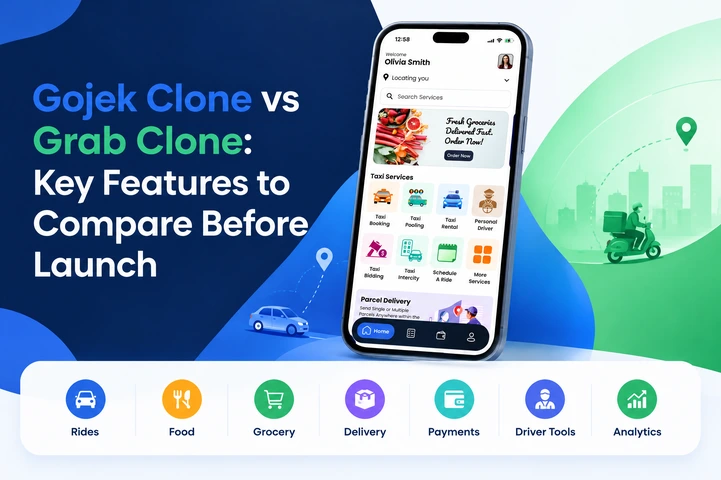
Effective Gojek Clone Features should offer more than just point-to-point cab booking. Businesses must be provided services such as pre-booked transportation, company commuting, outstation trips, shared transport, as well as bike and chauffeur services.
The same applies when evaluating Grab Clone Features. V3Cube’s current solution for the Grab app has all the features needed for taxi booking, bidding booking, corporate rides, intercity taxi rides, hiring a personal driver, rental process, two-wheeler booking, and shared rides.
This flexibility allows a business to introduce different transportation services as demand develops.
#3. Food, Grocery, and Parcel Delivery
Delivery is another major feature to consider. A super app becomes more useful when customers can complete several everyday tasks from one account.
An app like Gojek can connect taxi service with food, grocery, pharmacy, flowers or parcel delivery. Similarly, an app like Grab can also combine transportation and delivery services into one.
The business should examine whether the platform provides separate interfaces for stores, restaurants, delivery drivers, and administrators. These components are important because delivery operations are different from taxi operations.
V3Cube’s current multi-service platforms include store and restaurant management tools alongside delivery and transportation functions.
#4. Revenue Opportunities
One reason entrepreneurs consider a super app is the ability to create multiple revenue streams.
A platform can potentially earn commissions from taxi bookings, delivery orders, home services, store orders, subscriptions, advertising, cancellation fees, or other services.
A business does not have to launch every revenue channel immediately. It can begin with two or three strong services and expand after understanding customer demand.
The technology should therefore make it possible to add services without rebuilding the entire platform.
#5. AI and Automation
AI is becoming an important part of modern super apps. It can reduce manual work and help businesses manage large volumes of activity.
For example, V3Cube’s current Gojek solution includes AI-based surge pricing, automated payment reports, fraud protection, promo-code recommendations, AI booking assistance, and driver income support.
Its Grab solution similarly promotes AI-powered pricing, driver payouts, fraud prevention, promotional tools, and booking assistance.
These features can be useful when the platform starts handling thousands of bookings and orders.
What V3Cube Can Offer Better Than a Basic Clone
Many solutions in the market focus on providing a basic multi-service application. V3Cube’s current offering takes a broader approach by combining multiple service categories with AI-powered business tools.
Its Gojek solution currently promotes 101+ services, while the platform includes user, provider, store, website, admin, dispatcher, billing, corporate, and other panels.
For entrepreneurs, this means the platform can be structured around a broader business operation rather than only providing a basic clone of an existing application.
Which Model Should You Choose?
There is no single model that fits every entrepreneur. A business planning a broad ecosystem of everyday services may want to prioritize the wider service flexibility associated with a Gojek-style platform.
Another business may want to begin with transportation and delivery before gradually adding other services, making a Grab-style structure worth considering.
The most important step is to identify your target customers, launch market, initial services, provider network, pricing model, and expected expansion plan. Once these are clear, it becomes easier to select the right technology structure.
Conclusion
The choice of Gojek Clone vs Grab Clone is as much a business model decision as a technology decision. Both methods can be the platform for a multi-service business in essence, but as far as the businesses are concerned, the value will depend on how they are customized and managed.
A successful super app needs more than multiple services. By analyzing the areas even before the launch of the app, entrepreneurs can pick the platform that will suit their needs at the beginning and in the long term.
FAQs
Q1. What is the main difference between a Gojek Clone and a Grab Clone?
A Gojek-style model is often considered for a broader everyday-services ecosystem, while a Grab-style model can be built around transportation and delivery.
Q2. Can a Gojek Clone support more than taxi services?
Yes. A Gojek-style platform can combine taxi booking with food delivery, grocery delivery, parcel services, home services, professional services, and other categories depending on the solution.
Q3. Can I customize Grab Clone Features for my business?
Yes. The features, brand, service categories, cost of services, payment options, languages, currencies, etc., can be adjusted based on the business needs and requirements.
Q4. Is AI useful for a multi-service app?
Yes. AI can assist with pricing, fraud detection, booking support, promotions, payment reporting, demand-related decisions, and other operational processes.1

Chirag Darji is the CEO of V3Cube, specializing in building on-demand mobile apps and providing mobility solutions for companies around the world. With extensive experience in strategic planning and innovation, he helps entrepreneurs worldwide launch, scale up, and grow successful digital businesses.