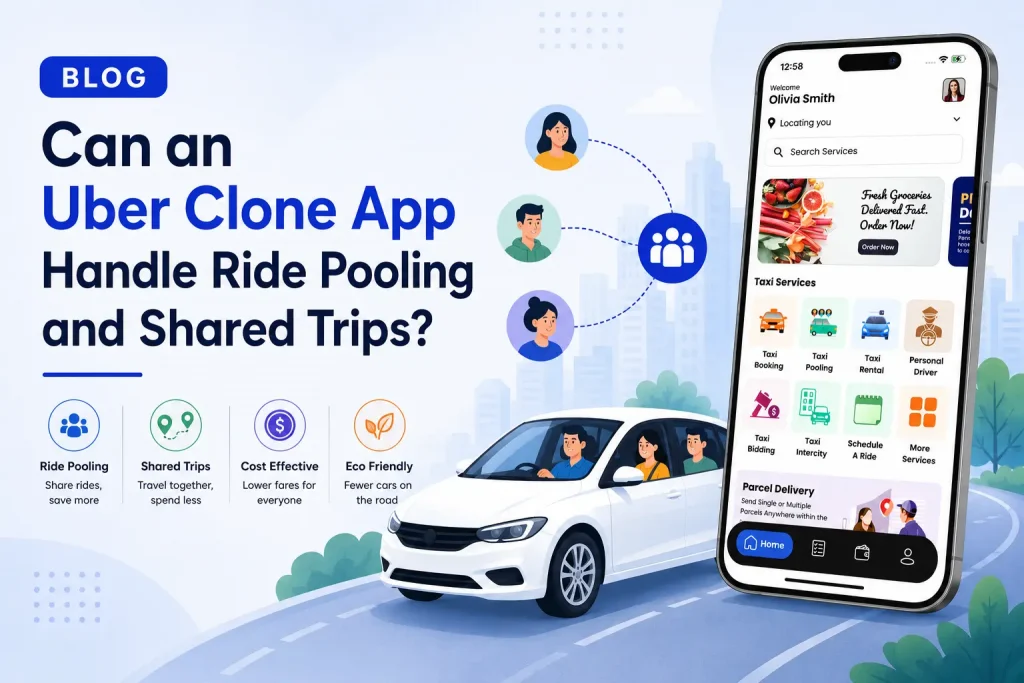
The short answer is yes.
Many founders start by looking at Pool or Share Taxi as just another booking feature inside the app. In some ways, that is true because most modern Uber Clone apps already support the basic setup needed for shared rides. But once multiple passengers begin sharing the same vehicle, things become more complex behind the scenes. Route management, pricing, driver availability, pickup timing, and seat occupancy all need to work together smoothly in real time for the system to run properly.
Having this feature built directly into the Uber Clone app does not require separate development or extra licensing, which makes it one of the more accessible services to switch on from day one.
Building a sustainable revenue layer inside a shared taxi business depends on multiple moving parts that keep changing over time. Much of the complexity comes from the economics behind the system itself, especially when pooled rides start reshaping both driver earnings and passenger expectations at the same time.
Many platforms discover this only after operations become harder to control day by day. Shared taxi services cannot be treated as a simple feature added inside the app because the model changes how dispatching, pricing, driver allocation, occupancy rates, and ride efficiency need to be monitored together as one connected operational system.
How the Pool/Share Taxi Feature Works Inside an Uber Clone App
Look at a standard taxi ride like a private charter flight. One person books the whole car for a set trip. The money is clean, and the logistics are simple. But a shared taxi is completely different. It is much more like a commercial airline. Multiple people buy individual seats on the same route. They each pay a fraction of the fare, and the driver completes one trip while the Taxi Booking App collects commissions from several different bookings at once.
It sounds great, but you have to remember what makes airlines so complicated. Coordinating boarding, managing detours, and dealing with passengers who have completely different schedules is tough. Those same pressures apply on the street level.
For the founder, you earn more commission per mile. For the driver, they maximize their earnings without burning extra gas. And for the passenger, they get a cheaper ride just for putting up with a small detour. When it works, it is a great setup for everyone involved.
Making Pool/Share Taxi Operationally Sound: What the Platform Infrastructure Must Deliver
Turning on a shared taxi feature does not mean you need to build new technology from scratch. The Uber Clone Script already has everything you need built right in.
1. Deploying Route Optimization and Dynamic Routing
One of the first operational improvements many shared taxi platforms introduce is AI-powered route optimization. Instead of assigning rides statically, the system continuously checks whether an active vehicle can accommodate another passenger without creating unnecessary delays or long detours. As new riders join during an ongoing trip, the platform recalculates pickup orders, drop sequences, and route efficiency in real time to keep occupancy high while maintaining acceptable travel times for everyone inside the vehicle.
2. Using the Heat View and Demand Prediction
Shared taxi systems rarely struggle because of ride-matching technology alone. The real challenge begins when drivers are spread unpredictably across the city while pooled ride requests start appearing in clusters. That gap between rider demand and driver positioning is exactly where delays, inefficient routing, and missed pooling opportunities start building up, even on platforms with strong infrastructure.
Founders running shared taxi operations need to think beyond enabling a feature inside the taxi app. Heat maps and demand forecasting should be used to position drivers in high-traffic corridors before peak hours begin, so the platform is already prepared when ride demand starts rising.
3. Configuring Fare Splitting and Per-Seat Pricing
Per-seat pricing introduces another challenge that many shared taxi platforms underestimate. Pricing the shared fare too aggressively may attract riders initially, but if nearly everyone shifts toward the cheaper option without a meaningful increase in total bookings, the platform slowly starts reducing its own per-trip revenue. The goal is not simply to make shared rides cheaper. It is to balance affordability with enough pricing separation to keep pooling sustainable at scale. Setting it too close to a regular fare removes the passenger’s incentive to share entirely.
4. Activating Auto Payouts and Wallet Systems
Handling the money is a delicate process since a single shared trip generates multiple commission transactions at the same time. One of the most effective ways to manage shared ride operations early on is through preloaded digital wallets and automated driver payouts, allowing earnings to be distributed accurately no matter how many passengers shared the trip.
This becomes especially important in situations where drivers question how a pooled fare was calculated. Instead of creating confusion around split payments, backend reporting gives a clear trip-level and driver-level earnings breakdown, helping operators resolve payout disputes quickly before they start affecting driver trust and retention.
Final Thoughts
Sparse service zones create a problem that many pooling models fail to account for early enough. In these areas, ride matching often falls apart, forcing drivers to complete individual trips while still operating under discounted pool pricing, which gradually reduces platform margins without improving efficiency.
Successful Uber Clone App Development around ride pooling depends on understanding how demand density, driver positioning, pricing behavior, and occupancy rates work together as one operational system rather than treating pooling as just another feature inside the app.
Tools like demand prediction, route optimization, auto payouts, and God’s Eye View all arrive pre-integrated from week one.

Chirag Darji is the CEO of V3Cube, specializing in building on-demand mobile apps and providing mobility solutions for companies around the world. With extensive experience in strategic planning and innovation, he helps entrepreneurs worldwide launch, scale up, and grow successful digital businesses.