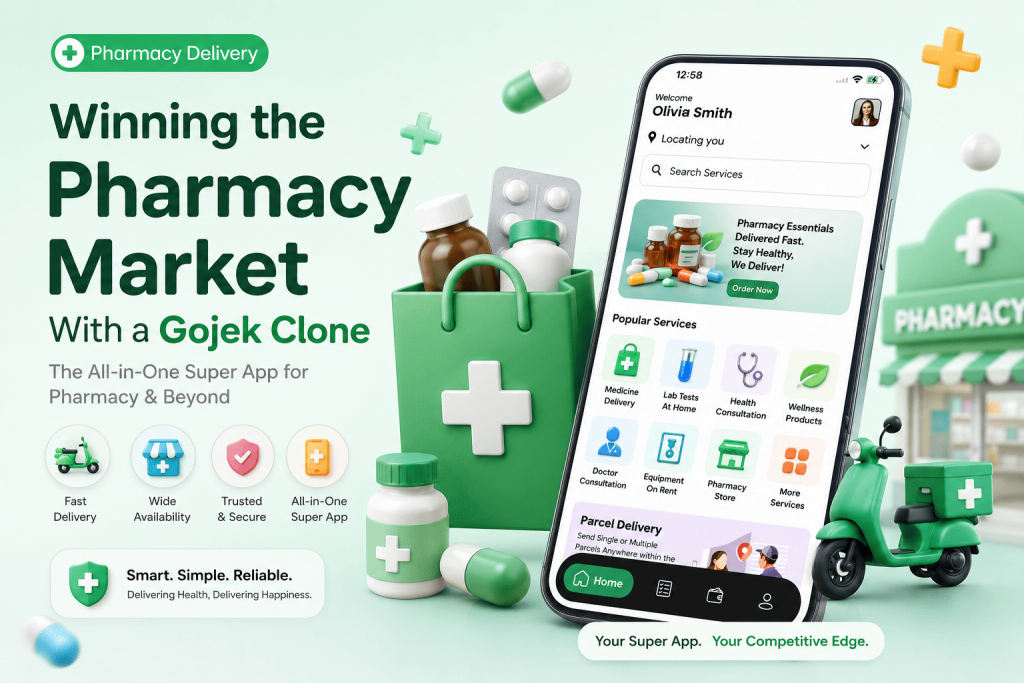
Pharmacy delivery is becoming one of the fastest-growing services inside modern healthcare super app ecosystems. Yet many entrepreneurs still treat it as a secondary feature instead of a major revenue opportunity.
A Gojek clone app that doesn’t highlight its medicine delivery app capabilities and treats them as a small feature rather than a major strategic element is missing out on one of the most important revenue streams in the 101+ services healthcare super app ecosystem. The demand in this market does not vary with time. It is not emerging demand, but consistently high demand.
The evidence is hard to ignore once you stop viewing pharmacy chains as a logistical challenge and start understanding them as a problem that technology has already solved.
Why Gojek Clone Apps Are Suited for E-Pharmacy App Development
According to SNS Insider, the global online pharmacy market was valued at roughly $131.77 billion in 2024 and is projected to reach approximately $472 billion by 2032. Because of this, running a profitable pharmacy delivery service requires more attention to detail than most other delivery categories on the platform. Yet, this complexity is also what makes a prescription delivery system a strong business advantage. Competitors who fail to set up proper verification and compliance systems simply will not be able to offer the service, which naturally reduces your competition.
A well-built Gojek clone app already contains the basic components needed to run a compliant healthcare delivery platform for pharmacy operations. Within the standard store delivery module, pharmacies are listed as a regular category alongside groceries, food, and other daily items. The admin panel allows you to set your service radius, apply geofencing to specific zones, and manage commission rates by category.
Building Pharmacy Delivery as a Major Strategic Element Inside Your App
The operational and commercial opportunity in online medicine ordering is large, but it only works when business owners configure and position the category properly rather than treating it as just one of many delivery types that all receive the same treatment. Here is how to approach each step.
Understanding the Repeat Prescription Delivery System Opportunity
A user who books their monthly medication refill through your app using a scheduled booking instead of visiting a physical pharmacy becomes a steady source of revenue rather than a one-time transaction. The app supports both instant and schedule-later booking flows for its delivery services.
When applied to an e-pharmacy app, scheduled delivery changes an irregular transaction into something similar to a subscription, without requiring platform owners to build a subscription product from scratch. The user sets a monthly reminder, the pharmacy partner fulfills the order, and your app automatically earns a commission on every completed order. This recurring cycle creates predictable long-term revenue for the platform.
Onboarding Licensed Pharmacy Partners Rather Than Unverified Suppliers
Licensed pharmacy partners manage their own inventory, accept orders, and prepare items through the Store App, while your delivery riders handle the actual delivery. Separating the pharmacy’s job from the delivery job is not just a convenient setup. It is a legal requirement. The pharmacy partner holds the license. Your app handles the logistics.
This structure minimizes legal risk while allowing the platform to earn commissions on every completed order. Therefore, when recruiting pharmacy partners, startups should prioritize licensed and registered pharmacies over informal medicine suppliers, even if informal suppliers are faster to onboard.
A single legal issue from an unlicensed partner creates damage to your reputation that no marketing budget can easily fix. Choose pharmacy partners carefully, checking their documentation and clearly understanding what they are legally allowed to sell in your market.
Setting Up Geofencing for Your Healthcare Delivery Platform
Not every pharmacy partner you onboard will be able to cover your whole city. A licensed pharmacy in the northern part of your city naturally serves users within a specific delivery distance from that location rather than the entire city. The geofencing feature is the main tool used for managing this.
Entrepreneurs can set each pharmacy partner’s active service area directly from the admin panel, ensuring that users only see pharmacies that can actually deliver their order within a reasonable time. A user in the southern district who sees a pharmacy listed but gets a two-hour delivery estimate because the partner is on the other side of the city will likely not use the app again.
Setting up geofencing prevents this issue from happening. Also, the admin panel’s service distance controls allow business owners to slowly expand each pharmacy partner’s coverage area as more delivery riders are added nearby, rather than promising city-wide coverage before having enough riders to support it.
Connecting Digital Healthcare Services with Pharmacy Delivery
Your Gojek clone app should let users book appointments with medical experts, have video consultations with doctors, nurses, and physiotherapists, order medicines, book ambulances, and schedule veterinary services. The connection between Online Video Consultation and a medicine delivery app creates a complete digital healthcare services experience for the user that single-service apps cannot match.
A user who consults a doctor through the app’s video feature, receives a recommendation, and then uses online medicine ordering through the pharmacy delivery service, completes an entire healthcare process without leaving the app.
Using In-App Notifications to Improve Online Medicine Ordering Retention
In-app notifications are a common feature that lets the app alert users about offers and events.
For pharmacies, a notification sent to a user about 25 days after their last order – when their monthly prescription is likely running low – turns a simple reminder into a direct prompt to book again, without needing any manual customer service work. The user gets the notification, taps to reorder, and your app earns another commission on a sale that the notification helped create.
Across a user base of hundreds of recurring e-pharmacy app customers, the total revenue from sending regular notification reminders often exceeds what most startups earn from a full month of food delivery promotions.
Using a Medicine Delivery App to Build Trust for the Rest of the Platform
There is an important benefit to pharmacy delivery that goes beyond just making money. Across 18 international markets, 33% to 43% of consumers already purchase medicines or health products online, with adoption strongly driven by convenience, availability, and time savings. This preference shows something more than just convenience: it shows that users trust digital healthcare services to handle sensitive things like healthcare.
A user who trusts your prescription delivery system to deliver their blood pressure medication correctly and on time has given you a level of trust that no food delivery or taxi booking app can create. This trust remains when the same user later considers booking a beauty service, a home cleaner, or a video consultation with a doctor through the same app.
Final Thoughts
Although pharmacy delivery does not create the same launch-day attention as adding a taxi service or partnering with a popular restaurant chain. But when set up carefully, this service presents itself as a steady stream of income from users who open your app because of emergency situations, rather than because a discount code is expiring soon.
FAQs
1. Is pharmacy delivery a good service to add to a well-built super app ecosystem?
It is, and it is one of the more important ones. Unlike food or grocery delivery, pharmacy orders involve a higher degree of user trust and legal rules, which reduces the number of competitors who can offer the service without proper preparation.
2. What makes pharmacy delivery different from grocery or food delivery in daily operations?
The key difference is that pharmacy delivery app involves restricted products, some of which require a valid prescription before they are sold. This means entrepreneurs need to clearly define where the pharmacy chain’s responsibility ends and the app’s delivery responsibility begins.
3. How does pharmacy delivery keep users coming back to the super app ecosystem?
People who need repeat prescriptions are often the most reliable recurring users on any well-built super app ecosystem. They return on a regular schedule driven by medical need rather than discount codes.

Chirag Darji is the CEO of V3Cube, specializing in building on-demand mobile apps and providing mobility solutions for companies around the world. With extensive experience in strategic planning and innovation, he helps entrepreneurs worldwide launch, scale up, and grow successful digital businesses.