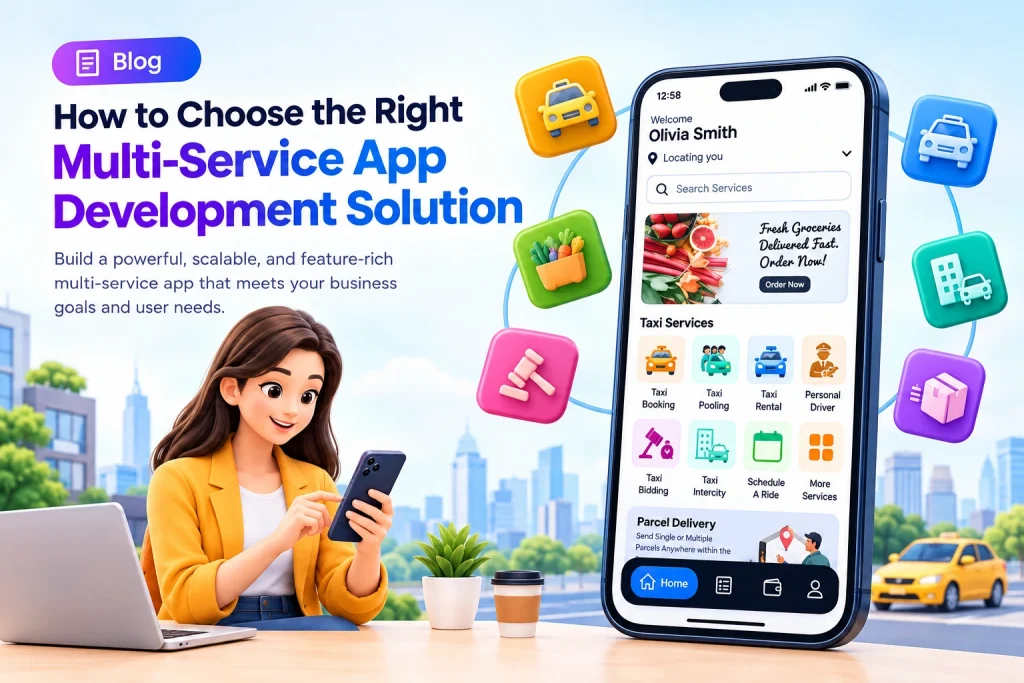
Businesses must select the right multi-service app development solution to deliver multiple services through a single digital platform.
Rather than developing distinct applications for taxi booking, meal delivery, grocery shopping, parcel delivery, and home services, the entrepreneurs can merge all those services into one ecosystem. However, not every platform provides similar flexibility, scalability, and business support.
To invest wisely, businesses should determine what is needed and what their technology partner can provide.
What Is a Multi-Service App?
A multi-service app allows customers to access different on-demand services through one application. The platform can connect users with drivers, delivery workers, restaurants, stores, and professional service providers depending on the business model.
For example, one customer may use the same account to book a taxi, order food, purchase groceries, send a parcel, or request a home service.
This type of model can give different revenue opportunities to businesses, which also makes this technology much more difficult to maintain. The reason for that is each service can have its own prices, workflows, booking processes, and operational characteristics.
For these reasons, there is a need to choose the right multi-service app solution, as it is not enough to compare features offered by each vendor.
Start With the Business Model
Before looking for a technology provider, businesses should define how the platform will operate.
Key factors include which services will be offered, who will provide those services, how customers will book those services, and the method to use for generating revenue. Revenue sources could consist of commission, service fees, delivery fees, subscriptions, advertising, or a mix of different approaches.
For example, taxi services may use ride commissions, while food delivery may combine restaurant commissions with delivery fees. Home services may use provider commissions or fixed booking charges.
The platform should support these differences rather than forcing every service into one business model. A clear business plan also helps businesses avoid paying for unnecessary features.
Check Which Services the Platform Supports
Not every multi-service platform supports the same categories.
Some solutions are oriented towards transportation or delivery only, while others are designed to serve a wider range of services. Thus, before beginning to select a provider, a business should create a list of services that will be provided at the launch point, as well as catagories the ones that will be introduced later on.
A convenient multi-service app may include taxi booking, food ordering, grocery and parcel delivery, as well as beauty, maintenance, pharmacy, and other services.
Still, having lots of categories does not mean that the business has to offer all of them. Starting with several services may simplify understanding the market and help understand future demand.
Look at the Complete Platform, Not Just the Customer App
One of the most common mistakes businesses make is judging a platform only by its customer application.
A successful multi-service business usually requires several connected interfaces. Customers are looking for a quick booking experience, while drivers and service providers want to have their own tools to accept orders and manage their availability and earnings, as well as communicate with customers.
Restaurants and shops need separate panels in order to manage inventory, products, pricing, and orders. Administrators need a set of dashboards to keep track of users, providers, orders, payments, commissions, and reports.
Therefore, when comparing multi-service app development services, businesses should examine the entire ecosystem rather than only the mobile application’s design.
Check Customization Options
Every market is different. A platform that works well in one city or country may need changes before it can operate effectively somewhere else.
Businesses need to verify whether the solution allows the customization of such aspects as branding, pricing, commissions, types of service, payment options, currencies, languages, rules of booking, and notifications etc.
Customization should also cover the customer journey. Taxi rides, food delivery, and home services may require completely different booking processes.
A good multi-service app development company should be able to explain what parts can be changed in the platform and what functionality is fixed. Many providers state that they can offer customization but only provide only some minor changes to the visual appearance.
Consider Scalability From the Beginning
A multi-service business can grow quickly once customers begin using the platform. The technology therefore needs to support more users, service providers, orders, locations, and transactions without creating major performance problems.
Scalability also means being able to introduce new categories. A business may start with cab and meal delivery and later add grocery, package delivery, or home services. This expansion should be easy to manage via the platform rather than making it necessary to rebuild the entire system.
This is all the more crucial for an on-demand multi-service app, where the scope of operations and types of services may increase rapidly during business growth.
Evaluate AI and Automation
Present-day multi-service platforms utilize artificial intelligence (AI) and automation in order to achieve less monotonous work and make better operational decisions.
Depending on the services offered, AI can also be used for dynamic pricing, spotting fraud, creating individualized promotions, booking assistance, analyzing demand, creating reports, and monitoring operations.
Moreover, automation can be utilized for disbursement to vendors, notifications, managing orders, and administrative reporting.
However, AI should not be evaluated simply as a marketing feature. Businesses should examine how each AI capability addresses an actual operational requirement.
For example, AI-based demand analysis may be useful for transportation, while automated order management may provide greater value for a delivery business.
Check Payment and Revenue Management
A multi-service platform may process many types of transactions. Customers can pay for taxi rides, restaurant orders, grocery purchases, delivery services, or professional appointments.
The technology should therefore provide a reliable payment structure and support the payment methods relevant to the target market.
Commission and payout management also require attention. A taxi driver, restaurant, delivery worker, and home-service professional may all have different earning structures.
The administrative system should make these transactions easy to track while providing clear reports for both the business and service providers.
Examine Provider and Admin Management
The quality of a multi-service platform depends heavily on the people and businesses providing its services.
Drivers require tools to register themselves, submit documents, indicate their availability, accept bookings, navigation, and make money. Restaurants and stores need product and order management. Service professionals may need appointment calendars and availability settings.
The admin team should have centralized control over all these categories. A strong platform should allow administrative personnel to approve providers, keep track of bookings, manage commissions, deal with complaints if required, add promotions, and carry out performance analysis of the company.
This operational foundation is just as important as the customer-facing application.
What V3Cube Offers Beyond a Basic Market Solution
Many providers offer multi-service applications with a limited number of predefined categories. V3Cube takes a broader approach with its Gojek-style platform, which currently promotes 101+ services and multiple interfaces for users, providers, stores, administrators, dispatchers, billing, fleets, and corporate operations.
The platform also supports multiple languages and currencies and can connect different service categories under one ecosystem. This can provide businesses with more flexibility when starting with a few services and expanding later.
Another area where V3Cube goes beyond a basic multi-service platform is AI and automation. Its current offering promotes AI-powered surge pricing, fraud protection, automated payment reports, promotional recommendations, booking assistance, and driver income support.
The solution also supports different booking channels, including mobile applications, websites, and WhatsApp. The solution enables consumers to have varied access to the services while offering operators more channels to manage the booking process.
When businesses are comparing multi-service application development services, they will find that the mix of service variety, multiple management panels, AI options, and access to various booking channels is a more solid base than a platform focused only on basic service booking.
Questions to Ask Before Selecting a Provider
Before signing an agreement with a multi-service app development company, businesses should ask practical questions:
- Can the platform support the required services?
- Can pricing and commissions be customized?
- Are separate provider and admin panels included?
- Can new services be added later?
- Does the system support multiple payment methods?
- What AI and automation features are available?
- Who handles updates and technical support?
It is also advisable for businesses to ask for a demonstration and to understand all the details of what’s included in the package. Being sure of all the aspects will ensure that later on there are no hidden costs in the development process and no limitations for operations.
Final Thoughts
The process of selecting a multi-service app development revolves around finding the middle ground between features, flexibility, scalability, and cost. A platform could certainly have hundreds of features, but these features matter only when they work towards supporting the business needs.
Businesses should first figure out the services that customers need, understand how revenue will be generated, and then find the technology needed for these goals.
A perfect platform should enable launching with a focused list of services yet provide opportunities for expansion in the future. Features like provider management, automation, payment solutions, customization, and scalability could make the multi-service platform a basis for the on-demand business.
FAQs
What is Multi-Service App Development?
Development of multi-service applications ensures the creation of a platform for the provision of multiple services to customers. Services may include, but are not limited to, delivery of food and groceries, transport, and delivery of parcels.
How much does a multi-service app cost?
The overall cost may vary because of the number of services offered, platforms provided, types of customization, payment systems, artificial intelligence capabilities, and admin tools used.
Can new services be added after launching?
Yes. A scalable platform should allow businesses to expand their service categories in parallel with customer base and operational growth.
What is an on-demand multi-service app?
An on-demand multi-service app connects customers with different service providers through one platform, allowing users to request or book services whenever they need them.

Chirag Darji is the CEO of V3Cube, specializing in building on-demand mobile apps and providing mobility solutions for companies around the world. With extensive experience in strategic planning and innovation, he helps entrepreneurs worldwide launch, scale up, and grow successful digital businesses.