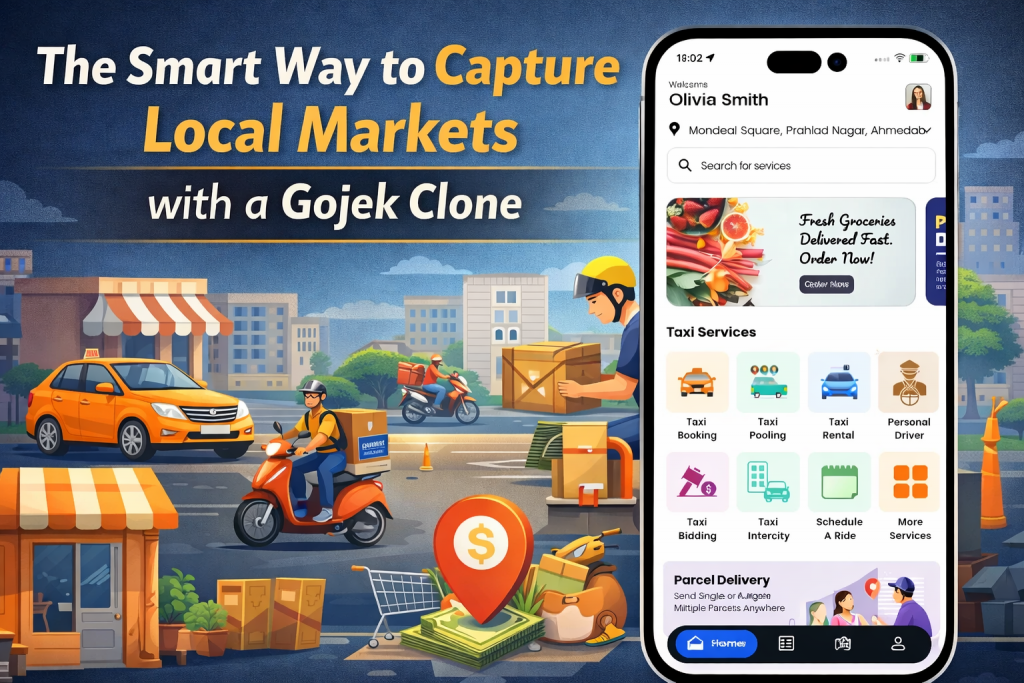
The way that people shop, order, and get about has been changing rapidly. In many places, consumers don’t need different apps that offer ride-hailing services, deliveries of food, groceries, home services, or parcel drop-offs. They prefer one app that is more. That’s the point where the Multi-Service App becomes valuable. It integrates multiple services all in one place, making the lives of users easier as well as generating new revenue streams for companies.
To U.S. founders and business owners, this concept is sensible since American consumers already appreciate speed as well as convenience and speedy service. A well-designed Multi-Service App can meet local requirements, aid small businesses in connecting with more customers, and build a more robust service-oriented ecosystem on one platform. Humans love to combine the ten different tasks into one application, and surprisingly, it can work.
Gojek and Its Impact on Southeast Asia
The Multi-Service App is inspired by a model that was successful due to the way that Gojek changed the way users in Southeast Asia used services. It was not only a ride-hailing service. It also expanded to food delivery, payment for groceries, delivery services, and much more. The combination made it effective in everyday life, not only every now and then.
The real value of the app was the solution to a fundamental issue. There was a need for one app that could meet various requirements. Drivers need more opportunities to earn. Local stores required more orders. Customers wanted quicker access to service. Gojek brought all three sides within one system, which led to an increase in the region.
For the markets of the United States, the lesson is obvious. Multi-service apps are not simply a trend. It’s a viable business model that can be used in cities or suburbs and smaller towns where trust and convenience are crucial. A solid multi-service app can introduce the same model to an entirely new market, with local adjustments that are in line with American users’ habits.
How Are Local Businesses Getting Affected Across the Globe?
The Multi-Service App can affect small businesses locally in a significant manner because it alters how consumers discover and purchase products. Smaller businesses are often struggling with visibility. They might have a great product or service; however, they do not have enough reach online. A shared platform allows users to access a larger audience without requiring them to create an entire application from scratch.
For instance, a nearby grocery store could become a part of a same-day delivery service that is same-day. A local restaurant could receive more orders. A mechanic, cleaner, or courier service could be booked on this same system. Businesses do not have to be confined to one specific category. They can expand across many different services.
This is especially true for the U.S. due to the fact that local competition for business is fierce. Large platforms tend to draattention andn, information, as well as customers, from lesser competitors. A carefully planned multi-service app development strategy gives smaller companies the chance to be prominent and profitable. It is also able to support regional and suburban markets in which national apps might not be able to meet all needs effectively.
There’s another advantage too. Local businesses are able to build confidence faster when they’re part an online platform that is organized and trustworthy. When customers are able to track the progress of their orders, clearly see the price, and read reviews, they tend to purchase. It is not an option in online commerce. It’s the product that is.
A Multi-Service App Can Help in the Distribution of All the Essentials to the Common Man
The Multi-Service App can transform into a platform for daily use for everyday users. This is the real potential. It’s not just an app to deliver food. It is a link between the people and the necessities they require on a daily basis.
Imagine a client who requires lunch, groceries, and medicine, as well as transportation and parcel delivery. Instead of opening five applications, the customer opens one. This reduces time and the amount of friction. In bustling American urban areas, this type of convenience is a good fit for how people currently live. In markets in suburban areas, it may help provide a solution in areas where access to services is not as fast or centralized.
The same model is also able to provide emergencies. If someone is busy or ill or is without an automobile, the Multi-Service App can assist them in getting what they need more quickly. This can include food items, personal care items, home supplies, and local courier services. It is useful for both planned and unplanned circumstances.
From a commercial perspective, from a business perspective, this leads to repeat usage. The users do not only return when they’re hungry. They return, as the app is an integral part of their daily routine. This is the true value of a super-app style model. It transforms one-time transactions into a routine.
How Does a Multi-Service App Benefit Businesses?
The Gojek clone benefits companies in a variety of ways. First, it allows numerous income streams within one platform. Businesses can earn revenue through ride services, delivery services, reservations, or subscriptions and commissions, as well as premium positioning. It’s much superior to relying only on one small stream.
It also reduces the expense of acquiring customers. Making separate applications for each service is expensive and takes a long time. Using multi-service app development, businesses can launch quicker, evaluate the market, and expand only one service at a time. It is crucial for entrepreneurs who wish to expand their businesses without spending time and money on expensive software. Since it seems that people love developing complex tech solutions to accomplish basic business objectives.
Third, it increases the use of data. Multi-service apps provide businesses with more insight into their customers’ habits and peak hours, as well as demand for services and repeat behavior. The data can help companies make better decisions. They can alter pricing, delivery zones, coverage of services, and other promotions based on actual usage.
Fourth, it enhances retention. If one person uses the app to order food, another to order, and yet another to hail a ride, the platform will get more points of contact. More touchpoints typically translate to more trust and greater return. For a U.S. business, that can lead to stronger local customer loyalty and better lifelong customer value.
Additionally, it allows collaborations. It is a multi-service app that can connect freelancers and independent businesses, as well as stores and service providers, into a single digital network. This is beneficial for franchise owners, local businesses, and start-up founders who seek to grow without sacrificing flexibility. It helps create a system in which all can benefit from the same customers.
Why the U.S. Market Is Ready for a Multi-Service App
It is believed that the U.S. market is a good match for the Multi-Service App because users already have a preference for app-based services. They can order food or book rides, organize cleaning, and purchase essentials on the internet. What they don’t always have is one platform that connects all these services in a more efficient and local manner.
There is also the possibility of niche positioning. The platform could focus on cities, a metro region, a university town, or even a suburban area. It could support local businesses instead of trying to replicate the model of a large national platform. This local focus could be an enormous benefit.
If you are a founder, it means that the opportunity is not just technical. It’s a strategic one. A solid multi-service app is not about copying an existing application. It’s about building an effective service ecosystem that is compatible with the everyday life of customers across the U.S.
Conclusion
The Multi-Service App can be more than just a multi-service program. It’s a business model that is built on trust, convenience, and everyday utility. It allows users to access essential services more quickly, aids local businesses in growing, and provides founders with the opportunity to build an even stronger online service system.
In those in the U.S. market, the timing is perfect. Customers demand speed. Businesses need visibility. Communities need better access to local information. A well-designed platform is able to provide all three. This is why Gojek clone app development is worthy of the attention of any entrepreneur looking for longevity rather than another app that nobody ever uses more than once.

Chirag Darji is the CEO of V3Cube, specializing in building on-demand mobile apps and providing mobility solutions for companies around the world. With extensive experience in strategic planning and innovation, he helps entrepreneurs worldwide launch, scale up, and grow successful digital businesses.