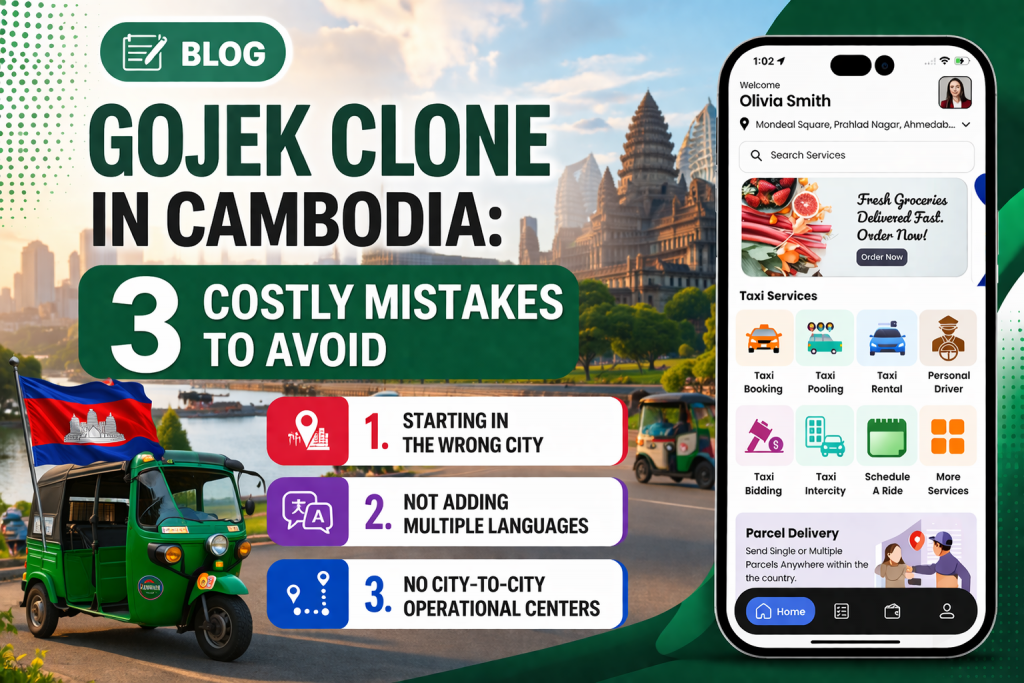
Gojek Clone in Cambodia: The Strategic Opportunity
The idea of a Gojek clone can be a lucrative business opportunity in Cambodia however only if it’s designed for the market and is not simply copied from another. Cambodia has 10.8 million Internet users at the time of 2025. This was followed by 60.7 percent of them being online that shows a significant online audience for apps.
For U.S.-based agency founders, founders and app companies. This is important because Cambodia isn’t a “build it, and the people will follow” market. It’s a market where trust, convenience, and local fit determine whether users continue using the app or remove the app after a single trial. The official language in Cambodia is Khmer and the localization process is not a choice. This is the first indicator of your platform’s respect for the user.
This is the point at which this is where Super App Development can be valuable. A super app that is well-designed can integrate ride-hailing services foods delivery, services for couriers and many more services in one place. This model is most effective when the pricing, product, operations, and language are in line to the local market rather than being pushed into it.
The opportunity is there. However, the margin of error is extremely small.
Why Localization Matters in a Gojek Clone in Cambodia
Localization goes beyond translating. It’s the entire process to make the app feel natural to the users who utilize it.
In Cambodia that’s a requirement. The application must match how people talk and pay, the way they move and also how they deal with everyday issues. The country’s logistics and transport sector is still plagued by issues as well as it is the World Bank has noted that the cost of transport and logistics are a major obstacle to efficiency.
This creates an excellent opportunity for services that are available on demand. However, it also means that the company must be well-organized and efficient. The app for service can only be as effective as the execution it has locally. If a driver arrives late or a delivery company is absent or support is slow the customer does not fault “infrastructure.” It is the fault of the application.
This is the reason it is important that a Gojek Clone in Cambodia should be developed with local ideas right from the beginning, and not later added as patches.
Mistake #1: Starting in the Wrong City
One of the most common mistakes in launching is to start in the largest city because it looks good on a pitch board.
This is the way founders burn money. They misinterpret size as their readiness.
It is advisable to start in the Tier 2 cities, like Banteay Meanchey , where you can gauge the market, create an infrastructure for service delivery and improve the operational strategy before entering a tougher market. It’s not about trying to be those who have the “coolest” town. It’s about managing the launch.
What makes this work?
A city that is smaller allows you to be more knowledgeable. You can monitor what services are used by people instead of making guesses from a boardroom. You can check pricing and the density of riders, delivery zones and customer support without having to battle head-to-head with largest brands in the nation. Because the market is smaller the local team can detect issues faster and correct the issues faster.
This is even more important in Cambodia because logistics and transportation aren’t fluid. World Bank reporting shows that logistics and transport costs are the biggest bottleneck. Road transport is responsible for the majority of all domestic travel.
The launch strategy must be easy. Start where you have the potential to be successful and not where you could boast.
Mistake #2: Not Adding Multiple Languages
This mistake appears like a small omission. This isn’t the case.
The official language of Cambodia is Khmer, the constitution makes it clear. If your application only speaks English it is telling the majority of users that your product was designed to be used by someone else.
This is not a good business model.
A solid Gojek clone is expected to be able to support Khmer first, and English as a layer if required. The goal is not to look elegant. The goal is to make the app simple. The app should be understood by users without effort. Buttons, menus, services labels and alerts, prompts for payment and help content must appear natural.
Multilingualism can be beneficial to improve your life in three different ways.
In the beginning, they establish trust. Users stay longer in apps that are familiar. Additionally, they increase conversion because the user doesn’t have to figure out what a button does. Thirdly, they can reduce problems with support. A majority of the customer’s confusion is due to an unprofessional design for language, accompanied by fake mustaches.
This is particularly important in the context of Super-App Development since multi-service apps are more complicated than single-purpose products. If the language is not strong it makes the entire experience feel weightier than it really is.
A Cambodia launch shouldn’t feel like something that is imported. It should be a feeling of home.
Mistake #3: No City-to-City Operational Centers
This is the error which is the biggest irritant in the long run.
Founders usually spend a lot of energy and effort on the interface for their apps and do not pay enough attention to the system that powers it. However, the system behind a Gojek clone in Cambodia isn’t just software. It’s a community of drivers, merchants, delivery partners, support agents as well as city managers.
If there aren’t any operating centers at the city level and the business is weak and sluggish.
What is the significance of this?
Since service companies fail in the field, they are able to fail in the app. A neat interface will not fix a late pickup. A nice logo does not solve driver turnover. White-label platforms cannot solve the problem of an inexperienced operations team.
The economy of Cambodia is still in the process of developing its logistics and digital infrastructure. It is the World Bank has described the digital economy of the country as being constrained by issues like limited use of financial services via digital as well as skills gaps and dispersed systems. This means that businesses have to perform more of the work itself.
Operational centres assist you in doing this.
They enable you to board drivers speedier. They assist you in managing local vendors. They can improve the customer experience. They improve service quality. Uniform from one city from one to another. Additionally, they provide you with the ability to make decisions locally instead of having everything run through the same office.
If the app is your front door, the operations are in the house. The people do not live in a house without power or broken pipes.
What a Smarter Launch Looks Like
A better plan of launch for a Gojek clone in Cambodia is as follows:
Begin by choosing only one city. Choose a market that you are able to quickly learn and efficiently manage supply. Create Khmer-first flow of products. Include English as a support language, but not as the primary language. Establish local operational support prior to your expand. Expand only after the initial city is stable.
This is the difference between creating an enterprise and playing the stage in the start-up world.
Don’t think of the development of Super Apps as an effort to include each service from day one. Make sure to add the services people require first. In many markets, that is the essential utilities that help save time and cut down on friction. When users are comfortable with the app then you can extend it into other areas.
This is why white-label development can be beneficial for a variety of businesses. It reduces the time to launch reduces risk and offers a foundation to modify to Cambodia instead of starting from scratch. The white-label option is just the beginning. The true benefit is local execution.
This is the area that teams tend to overlook.
Conclusion
The idea of a Gojek clone in Cambodia is possible however, only if it is launched in a manner that respects the market.
The country has a rapidly growing digital audience, a clear demand for improved quality service, with an enormous potential for platforms that are on demand. The internet population of Cambodia is huge enough to support a serious app business and logistics issues can make super apps extremely valuable.
But the success won’t be achieved by copying a model and changing its name. It will be due to the localization.
If you’re planning to Gojek clone in Cambodia launch, using Super App Development, the best strategy is to focus on local users first, then scale and only move after your app is able to withstand real-world users.

Chirag Darji is the CEO of V3Cube, specializing in building on-demand mobile apps and providing mobility solutions for companies around the world. With extensive experience in strategic planning and innovation, he helps entrepreneurs worldwide launch, scale up, and grow successful digital businesses.