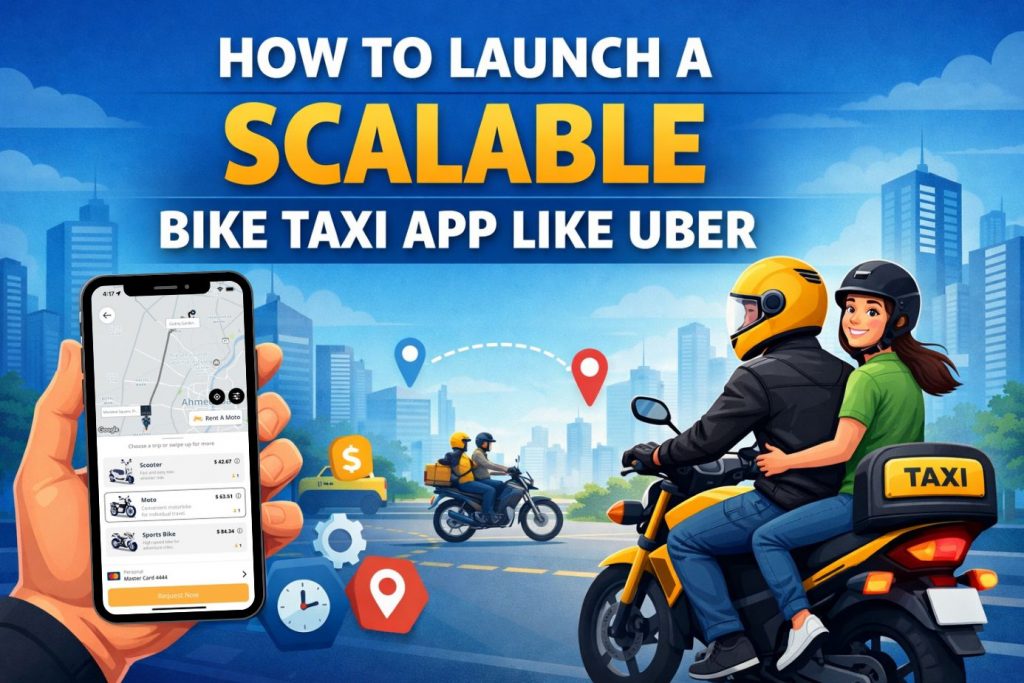
Bike Taxis & Its impressive Work
Developing nations like Brazil, India, and Argentina rely on speedy bike taxis which record for rapid growth in bike taxis. And the same kind of potential, lies in regions like USA, Africa, and Europe. The important part is that giants like Uber don’t benefit enough in such models due to their ‘One App Fits West’ model. This is where the opportunity and a clear gap in the market arrives.
Even though Giants like Uber, Lyft, Bolt, and Yandex Go offer bike taxis, their cost-effectiveness and profit margins are not apt for consumers, which is the whole point for starting a bike taxi model. This is where you can launch with starting your own Uber Clone specifically designed for Bike Taxis.
In this blog, you’ll learn about how Bike Taxi apps can be developed and launched, and also how to attain a market share by understanding the ‘Rapido’ model.
A little Bit More about Uber Clone
Uber Clone most popularly known for ride-hailing solutions, is a pre-built taxi app which easily books taxis in a few taps just like Uber. What’s different is that it can be launched by anyone an entrepreneur who wants to aggregate taxis and earn via commissions, or a fleet who wants to streamline and grow their taxi business. An Uber clone script comes with these specific deliverables:
- Android & iOS Apps for drivers
- Android & iOS Apps for users
- A functioning website (with Taxi Booking)
- A Robust Admin Panel
- Supporting Panels with Admin Panel
- Kiosk Apps (optional)
Now that you know about the Uber clone script, let’s understand how you can launch a Bike Taxi App. To begin with significance, let’s understand what features you should have in your Uber clone.
Features You Should Get in a Bike Taxi App!
Features are the most important part for any app. In a bike Taxi app, where speed and convenience matter the most, the features must be built around the same concept. Thus, you need to mandatorily add these 7 features in your bike taxi Uber clone.
1. Smart Login
Your drivers and riders can sign up and login with just a few seconds using OTP Social logins, OTP, or via email. An easy onboarding experience reduces drop-offs, and increases your active user base.
2. AI-Powered Route Optimization
The app calculates intelligently the most efficient, fastest routes in real-time decreasing ride times and fatigue of drivers. This results in more rides per hour, more satisfied customers, and less operating costs. This is which is a win for everyone.
3. Automated E-invoice Generation
Each completed trip automatically generates an invoice in digital format and then sends directly to the user’s app or via email. It keeps your platform looking professional as well as transparent and audit-ready, without manual effort.
4. AI-Powered Dynamic Pricing
Pricing changes automatically in response to the weather, traffic, demand and even the time of the day. It’s similar to Uber’s surge system, however, it is more efficient. This increases your earnings during peak times, while keeping your rides attractive in off-peak hours.
5. OTP Confirmation
Before starting a ride the rider and driver verify the trip using an individual password, preventing fraudulent pick-ups or wrong pickups. This is a simple step that creates massive trust in your system.
6. Identity Verification for Drivers & Riders
The built-in KYC along with document authentication guarantees only authentic, verified drivers are on your platform. This helps protect your brand’s reputation and gives customers an assurance to make bookings their rides without doubt.
7. in-App Wallet
Customers can pre-load credits to pay in a flash without any hassle with cash or card at the end of each journey. If you are an owner of the platform, it will also result in quicker settlements and improved transparency of cash flows.
These features ensure everything’s in place while also adding a sustainable commute to the regional environment. With every feature convenience surges and with optimum commission rates you can get a powerful return rate while being cost-efficient. How, let’s understand how Uber clone’s multi-stream revenue model can offer cost-efficient profits.
How Does Uber Clone Help in Bike Taxi’s Profitability?
Bike taxis are built around the concept of being cost efficient. For example, if you’re in Nigeria you want to travel from point A to Point B alone, you’ll find 3 options. First is to book a generic cab which will cost you a good 3500 Naira, if you want to travel in car pool, it costs you 2500 Naira, but if you book a bike taxi you get a personalized experience like generic taxi and yet it costs you only 2000 Nair, which one would you pick? Of course the bike taxi!
Now, around this concept, a bike taxi app rarely earns 20-25% of the booking amount, which does not make sense for the highly commission dependent model. Plus, it exploits the drivers on a massive scale. Imagine you work 10 hours a day, you made 500 Bucks and then someone would take 30% cut into it, because they helped you earn those 500 bucks. This feels like exploitation to a major extent. This is where multiple revenue streams of an Uber clone helps. Let’s understand what these income streams are:
1. Commissions per Booking
Every time someone books a taxi, your app earns. You set percent cut of the cost of the ride. It is the most straightforward and reliable source of income. Make sure it is within a reasonable range (10-12%) to ensure that drivers are retained and still build a solid income base that is recurring.
2. Cancellation Fee
If a driver or rider cancels a confirmed reservation, there is a small fee to deter impulsive cancellations. This fee does not only safeguard the earnings of drivers but also goes directly into your platform’s revenues.
3. Surge pricing
In peak times like rush hour or festivals, the app automatically increases rates and the commission increases according to the increase. It’s a passive income that requires no additional effort from you.
4. Driver Subscription Fee
Provide drivers with premium plans that allow for better allocation of rides and priority listing or lower commission rates for a monthly charge. This provides a predictable, ongoing revenue stream from B2B that’s totally independent of the volume of rides.
5. in-App Advertisements
Local companies, fuel stations, restaurants, and other service businesses in your cities of operation are willing to pay for advertising in your application. As your users grow and your ads expand, so will your inventory, which turns the attention of your users into revenue.
So far, you understood the basic needs, and how do you make money out of the bike taxi app idea. Now, this is high time you understand development process and launch strategy.
How Much Time Will an Uber Clone Take in Development?
An Uber clone will take not more than 1-2 weeks to launch with complete customization and launch. How? Well, the software is pre-built and its customization is easy due to its plug and play concept. Here’s how the launch process works:
1. Purchase
You simply acquire the pre-built Uber clone script from a trusted white-label provider, which already comes loaded with all core features and architecture. This eliminates months of from-scratch development and saves you a significant chunk of your capital right at the start.
2. Customize
The solution is configured to match your brand identity, regional language, currency, pricing logic, and any service-specific tweaks you need. Think of it as plug-and-play, you shape the product around your business, not the other way around.
3. Launch
Once customized, your app goes live on Android, iOS, and the web; fully functional and ready to onboard drivers and riders from day one. You skip the beta nightmare and go straight to building your market presence.
This ensures everything is built around your business model and customized accordingly while cutting a significant development time and costs around it! Now, it’s time for launch, so let’s understand what your launch strategy should be.
Rapido Launch & Growth Strategy: Explained!
In India, the share of bike taxis lie around 57.28%, out of which Rapido has a concrete market share in cities like Mumbai, Kolkata, Bangalore, Ahmedabad, and many more. On top of it, the cities where they operate in are not just tier 1, but also tier 2 and 3 cities and villages where commute and network is slow. They got this network through this simple marketing strategies.
Referral Codes & Tiered Rewards
Rapido was able to break the early stage growth barrier through transforming its own users into an efficient distribution engine. Each rider who recommended friends earned credit to their wallets and the user received an early discount on their first-time ride, creating an ongoing acquisition loop that costs less than advertising paid for. If you are an entrepreneur, it is possible to have the ability to clone this model when you launch your business: establish an incentive system that is tied, so referrals earn you more benefits, and the most loyal customers are the most effective marketing.
Low Commission, Cost-Efficient Rides
In contrast to the giant platforms that burden drivers with commissions ranging from 25-30% reductions, Rapido kept its rates minimal, which translate to lower prices for riders and higher take-home pay for drivers. This dual-sided benefit proposition is what earned them confidence in the tier 2 and tier three cities where each cent is important. This means for you that you launch with a competitive low-commission business model right from the beginning and remunerating with the multi-stream revenue strategy. Thus, you expand the network rapidly without burning either side of your market.
Conclusion
The opportunity for bicycle taxis is real and expanding, and even more important the market is still accessible in many markets other than India. The gap created by giants such as Uber or Lyft in high-density, cost-sensitive areas is precisely the place where a localized, lean bike taxi company can succeed. With an Uber Clone, you’re beginning from scratch, but making smart choices. You’ll get a proven product with the ability to change revenue models, and a time-to-launch that is which is measured in days rather than months.
Learn from Rapido’s guidebook, ensure that you make sure your commission is fair, recognize your early community members, and grow the city one city at a time. The infrastructure is in place. The market is awaiting. Only thing you have to do is decision.
